Editorial context: practical handling ideas and questions are examples, not tested breed-specific outcomes or guarantees. Read the source scope and limitations below.
Training games and household examples are editorial applications, not breed-specific trial findings. Standards describe ideals, not individual predictions. Screening items are selected current pre-breeding signposts, not a complete list of illnesses or an individual health assessment.
A working history from Apolda
The Royal Kennel Club attributes the breed’s development to Louis Dobermann, a tax collector in Apolda, Germany. Later work included police and military roles. That history explains the name and working background; it is not a reason to teach a companion dog to guard people or property.
Look past the service-dog image
A working reputation cannot tell you how a particular Dobermann responds to visitors, handling or separation. Ask the current carer for concrete examples from ordinary days. Build your expectations around this dog’s experience rather than assuming that an impressive outline means confidence in every setting.
Editorial practice example based on general guidance, not a breed-specific trial finding.
Short hair with a close fit
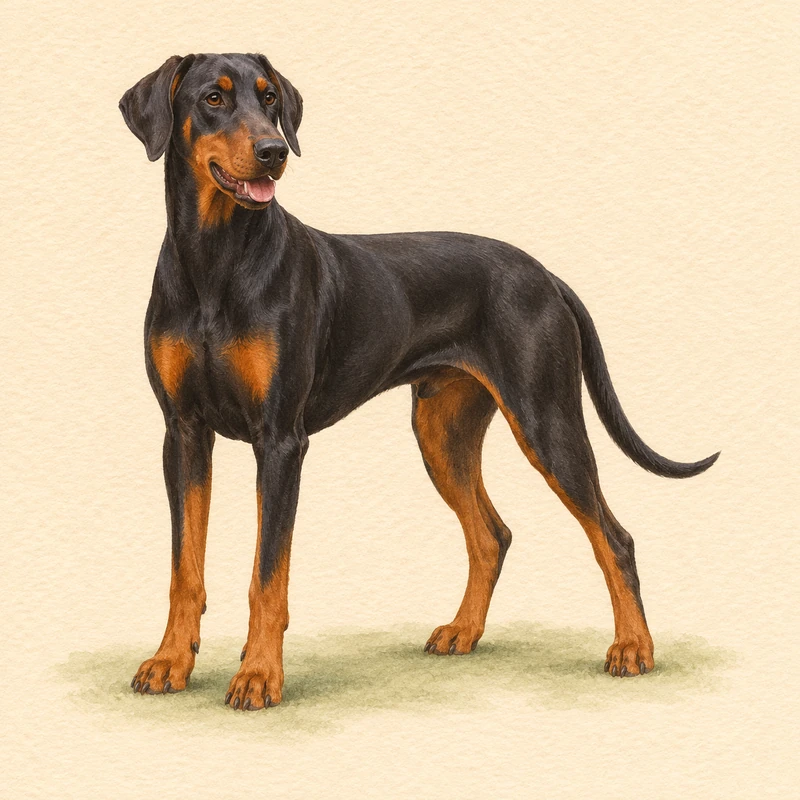
The standard describes a dense, short, smooth coat lying close to the body, with a firm texture. This is a description of hair, not proof of healthy skin. Notice whether contact is comfortable instead of judging care by shine alone.
Make a doorway pause easy
Reward a brief pause on a mat away from the front door. Practise without visitors first. This is a reward-based household exercise, not protection training.
Editorial practice example based on general guidance, not a breed-specific trial finding.
Start with the individual
Choose complete food for your Dobermann’s life stage and health with veterinary advice. A working-breed label does not itself specify a ration or specialised formula.
Editorial practice example based on general guidance, not a breed-specific trial finding.
Conditioning before ambition
Build activity gradually around current fitness. As a practical plan, alternate a comfortable walk with a quiet search game rather than making every outing a speed test.
Editorial practice example based on general guidance, not a breed-specific trial finding.
Record growth rather than chasing size
For a growing Dobermann, ask about food suitable for the expected adult size. Review growth with your veterinary team; extra calcium is not a shortcut to a stronger skeleton. Keep the feeding record when care passes between people.
Editorial practice example based on general guidance, not a breed-specific trial finding.
Ask specifically about cardiac assessment
Cornell includes Dobermanns among breeds predisposed to dilated cardiomyopathy. Ask your vet what heart assessment is appropriate, rather than relying on appearance. The linked Royal Kennel Club Dobermann record lists selected pre-breeding screening signposts, including DNA, hip and eye tests. Ask your vet to interpret the named tests and actual results. These signposts are not a complete list of illnesses or an individual health assessment, and do not collectively guarantee health.
Keep contact comfortable
Introduce brushing positively and match the tool to the short coat. Stop if the dog becomes uncomfortable; harder brushing is not better grooming.
Editorial practice example based on general guidance, not a breed-specific trial finding.

Prepare before the dog steps in
Set up a non-slip washing area first. Rinse dog shampoo thoroughly and dry afterwards; keep the session manageable rather than improvising around a slippery dog.
Editorial practice example based on general guidance, not a breed-specific trial finding.
Retching can be an emergency
Dobermanns are among the breeds Cornell flags for gastric dilatation volvulus (GDV), also called bloat. Repeated unsuccessful retching, a swollen abdomen, restlessness or collapse warrant immediate emergency veterinary care. Do not wait for a food change to help.