Editorial context: practical handling ideas and questions are examples, not tested breed-specific outcomes or guarantees. Read the source scope and limitations below.
Training games and household examples are editorial applications, not breed-specific trial findings. Standards describe ideals, not individual predictions. Screening items are selected current pre-breeding signposts, not a complete list of illnesses or an individual health assessment.
Named for an American city
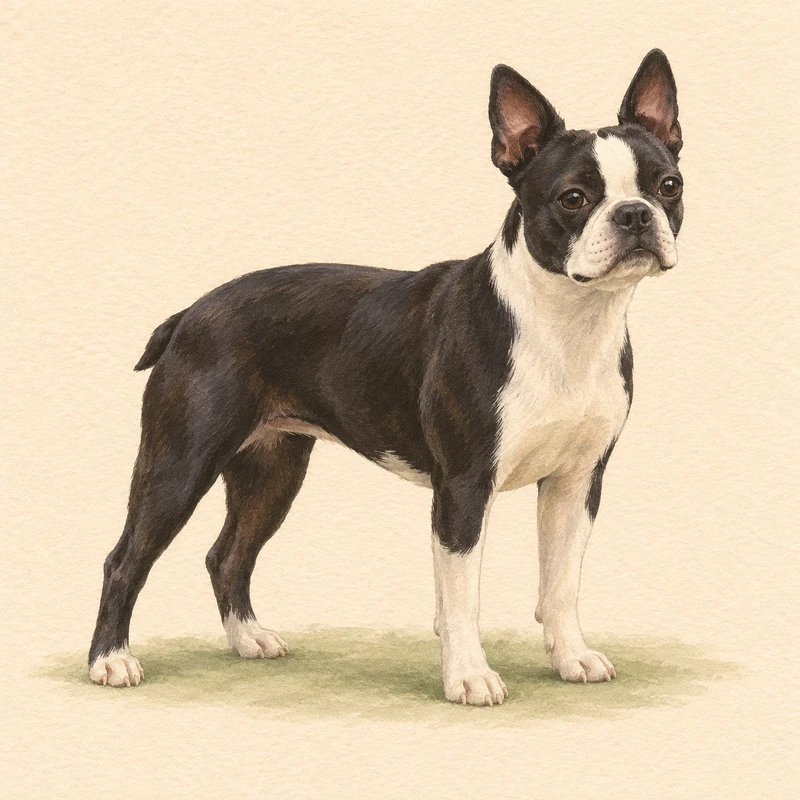
The Royal Kennel Club links the Boston Terrier’s development and name with Boston in the United States. Its historical account describes Bulldog and terrier ancestry. This is the Boston Terrier’s own guide, not a shortened version of care for another bull breed.
Small size does not settle suitability
The standard describes a lively and strong-willed ideal. Individual confidence and responses to noise, touch and visitors still need to be understood. Ask about the dog’s routine and offer choices in quiet settings instead of assuming a compact companion will enjoy being carried or constantly handled.
Editorial practice example based on general guidance, not a breed-specific trial finding.
A fine, smooth coat
The breed standard describes short, smooth hair with a fine texture. Coat appearance is only one part of daily observation. A tidy outline should not distract from how comfortably the dog moves, rests and accepts ordinary care.
Make quiet learning worthwhile
Reward an easy response in a calm setting and finish with a pause. Short, comfortable practice is the aim, not persuading the dog to keep performing.
Editorial practice example based on general guidance, not a breed-specific trial finding.
Review food and condition together
Select complete food for life stage and health with veterinary advice. A Boston’s size alone does not supply its correct portion; keep body condition in the conversation.
Editorial practice example based on general guidance, not a breed-specific trial finding.

Breathing comfort sets the boundary
Brachycephalic obstructive airway syndrome (BOAS) can affect Boston Terriers. Avoid excessive heat and humidity, and tailor activity to breathing comfort with your vet. Noisy or difficult breathing is not a fitness challenge to push through.
Editorial practice example based on general guidance, not a breed-specific trial finding.
Do not explain away new changes
Keep appetite and weight changes on the veterinary review list as your Boston ages. If breathing becomes noisier or activity harder, seek assessment rather than assuming age alone explains it.
Editorial practice example based on general guidance, not a breed-specific trial finding.
Separate eye and breathing checks
The Royal Kennel Club’s selected pre-breeding screening signposts list eye testing and a hereditary-cataract DNA test. Its record also notes respiratory grading recognised in August 2026, with formal Health Standard addition planned for January 2027. Ask for current records and veterinary interpretation. These signposts are not a complete list of illnesses or an individual health assessment, and tests for different conditions do not substitute for one another.
Keep grooming positive
Match the tool to the fine coat and introduce brushing gently. A brief comfortable session is more useful than insisting on finishing when the dog pulls away.
Editorial practice example based on general guidance, not a breed-specific trial finding.
Protect the face while washing
Keep water and shampoo out of the eyes, nose and ears. Rinse carefully and dry afterwards; use dog shampoo rather than choosing a product for its fragrance.
Editorial practice example based on general guidance, not a breed-specific trial finding.
A breathing crisis cannot wait
Severe breathing difficulty, blue-tinged gums or collapse require immediate emergency veterinary care. Cornell warns that BOAS can become a respiratory emergency. Do not dismiss distress as normal snorting for the breed or delay care to try a grooming or feeding change.