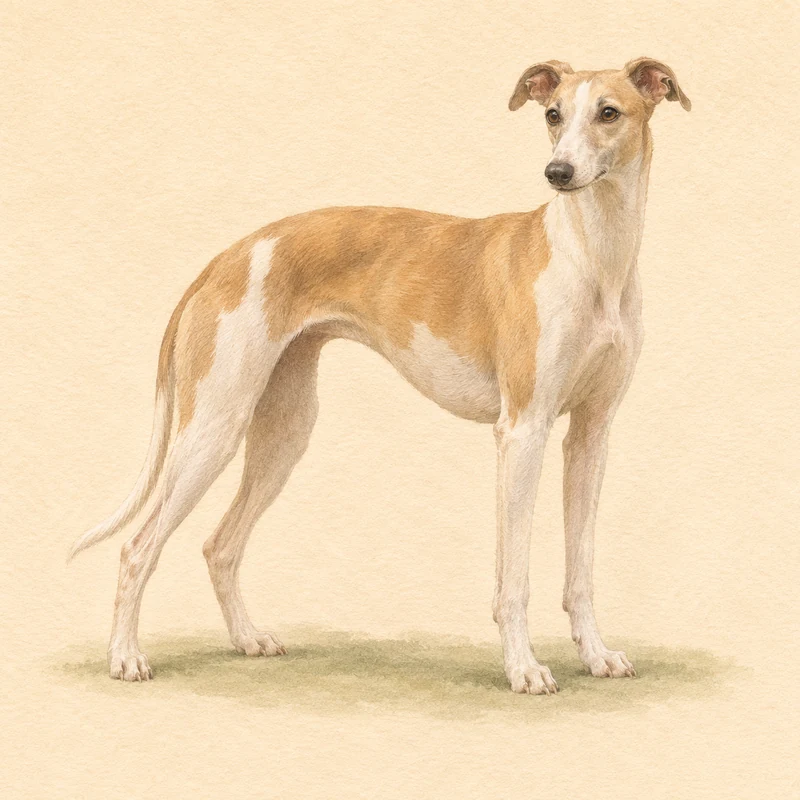
A sighthound with a racing past
The Whippet developed as a small-game hunting dog and later became associated with racing, including in British mining communities. It belongs to the sighthound group; it is a distinct breed, not simply a small Greyhound.
Read the evidence: Whippet breed background and health screening — Royal Kennel Club
Gentle is an ideal, not a guarantee
The standard’s ideal is affectionate and even-tempered. Ask about the individual dog’s comfort around noise, handling and unfamiliar situations. A calm first meeting is useful information, but it does not reveal every response in a new home.
Read the evidence: Whippet breed standard — Royal Kennel Club
A close, fine covering
The standard describes a fine, short coat lying close to the body. Coat length alone does not tell you which brush will feel comfortable.
Read the evidence: Whippet breed standard — Royal Kennel Club
Practise returning before distractions
Reward-based training is the starting point. One practical exercise is to reward returning to you in an enclosed, quiet space before asking for the same response near moving distractions. Keep safety arrangements in place while learning.
Read the evidence: Reward-based training — Australian Veterinary Association
Feed for life stage and health
Use complete life-stage food and discuss health-related dietary needs with your vet. A sighthound label does not replace an individual feeding assessment.
Read the evidence: Evaluating Pet Food — NC State Veterinary Hospital
Choose the running space carefully
Combine walks and exploration with suitable opportunities to move in a secure space. Check for sharp objects and uneven ground before off-lead activity. Tailor activity to the dog’s fitness rather than setting a speed or distance target.
Read the evidence: Whippet — PDSA
Revisit the plan as activity changes
Food portions need review when activity or body condition changes. For an older Whippet, discuss dietary needs alongside any health problems rather than assuming that age alone decides the food.
Read the evidence: Nutrition — Virginia Tech Veterinary Teaching Hospital
Ask what screening actually covered
The Royal Kennel Club’s current Whippet guidance highlights genetic diversity and points to a breed-club health scheme. Ask the breeder and vet what checks have been completed and what the results mean. A scheme listing is not proof that an individual dog has been tested.
Read the evidence: Whippet breed background and health screening — Royal Kennel Club
A soft approach
Use a soft brush gently on the short coat. Whippets can have sensitive skin; grooming should not become a vigorous scrubbing session.
Read the evidence: Whippet — PDSA
Keep it simple
Keep water out of eyes and ears and dry thoroughly after bathing. Ask your vet about skin irritation and a suitable bathing routine.
Read the evidence: Dog Grooming Tips — ASPCA
Comfort without assumptions
A Whippet may need extra protection in cold weather. Supervise interactions with children and provide space to withdraw. Neither a quiet reputation nor a slim outline is a guarantee of comfort in every setting.
Read the evidence: Whippet — PDSA
Sources & scope
Source retrieval dates are recorded individually below. Written as general owner education by Good Dog; not clinically reviewed or endorsed by the organisations linked below. Breed standards describe ideals, not guarantees. Screening advice can change. These are selected considerations, not a complete list of conditions.
- Whippet breed background and health screening — Royal Kennel Club
Historical background and listed screening; broad activity context.
Source retrieved 2026-11-11 - Whippet breed standard — Royal Kennel Club
Coat and temperament ideal; physical description.
Source retrieved 2026-11-11 - Reward-based training — Australian Veterinary Association
Positive reinforcement and avoiding fear/pain-based training.
Source retrieved 2026-11-11 - Evaluating Pet Food — NC State Veterinary Hospital
Complete life-stage food and individual veterinary advice.
Source retrieved 2026-11-11 - Whippet — PDSA
Selected exercise, grooming and supervised-interaction guidance.
Source retrieved 2026-11-11 - Nutrition — Virginia Tech Veterinary Teaching Hospital
Body condition, portions, treats and life-stage dietary review.
Source retrieved 2026-11-11 - Dog Grooming Tips — ASPCA
Selected bathing, brushing, fold drying and eye/ear warning advice.
Source retrieved 2026-11-11