Editorial context: practical handling ideas and questions are examples, not tested breed-specific outcomes or guarantees. Read the source scope and limitations below.
Scottish working roots
The Royal Kennel Club traces the Westie to white Cairn Terrier ancestry developed by the Malcolms of Poltalloch in Argyllshire. Poltalloch Terrier and Roseneath Terrier were earlier names. That background explains the terrier identity without predicting the behaviour of every modern companion.
Read the evidence: West Highland White Terrier background and screening — Royal Kennel Club
Confidence is an ideal
The standard calls for an alert, self-reliant and friendly dog. Do not turn that into a label of stubbornness when a dog is frightened or uncomfortable. Ask what motivates this individual and where extra support is needed.
Editorial application, not a breed-specific trial or guaranteed behavioural outcome.
Read the evidence: West Highland White Terrier breed standard — Royal Kennel Club
Two textures in the standard
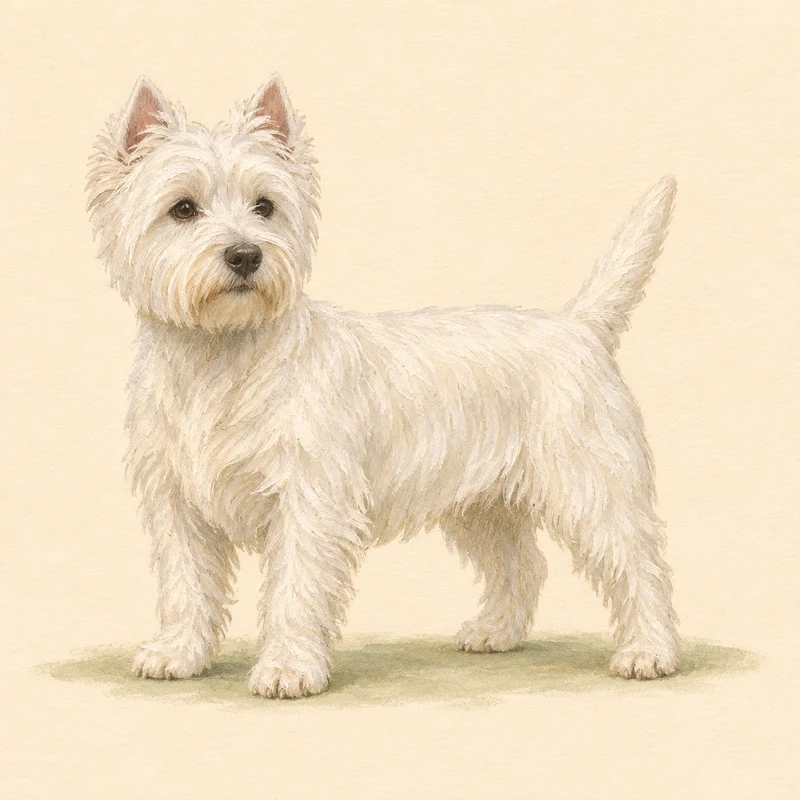
The Westie standard explicitly describes a harsh outer coat and a short, soft, close undercoat. A white surface does not show everything happening underneath; comfort and skin condition deserve attention alongside tidiness.
Read the evidence: West Highland White Terrier breed standard — Royal Kennel Club
Reward coming away
In a secure, quiet area, practise rewarding a turn back towards you. Add distractions gradually rather than using force when the dog finds something more interesting.
Editorial application, not a breed-specific trial or guaranteed behavioural outcome.
Read the evidence: Reward-based training — Australian Veterinary Association
Avoid coat-led food assumptions
Use complete food appropriate to life stage. If skin problems occur, ask your vet to assess them rather than choosing a restrictive diet from the breed name.
Read the evidence: Evaluating Pet Food — NC State Veterinary Hospital · Dog Grooming Tips — ASPCA
Offer a safe place to investigate
An unhurried walk with sniffing opportunities or a simple search for a familiar toy can vary the routine. Use secure surroundings and adapt to age and fitness. These are practical enrichment suggestions, not evidence that all Westies need the same exercise.
Editorial application, not a breed-specific trial or guaranteed behavioural outcome.
Read the evidence: West Highland White Terrier background and screening — Royal Kennel Club
Notice the whole dog
Review feeding when activity or body condition changes. New appetite or weight changes deserve a veterinary conversation rather than an automatic switch based only on age.
Read the evidence: Nutrition — Virginia Tech Veterinary Teaching Hospital
Skin is only part of the picture
A 2019 study of Westies in UK primary-care records from 2016 identified dental disease, ear disease and allergic skin disorder among commonly recorded problems. Those records do not predict your dog’s future. Include mouth, ear and skin comfort in routine veterinary conversations, and seek advice for persistent irritation rather than assuming it is simply a Westie trait.
Read the evidence: West Highland White Terriers under primary veterinary care in the UK in 2016: demography, mortality and disorders · Dog Grooming Tips — ASPCA
Gentle care under the outer coat
Check for knots where equipment rubs and work gently. If skin is sore or the dog reacts painfully, stop and seek veterinary advice.
Read the evidence: Coat Care: Preventing Matted Hair — USDA APHIS · Dog Grooming Tips — ASPCA
Let skin comfort set the plan
Ask your vet about bathing when skin is irritated. Rinse thoroughly and dry carefully; extra scrubbing is not a solution to persistent itching.
Read the evidence: Dog Grooming Tips — ASPCA
Arrange a comfortable grooming routine
Ask a groomer to explain upkeep for your Westie’s actual coat and show which checks you can do gently at home. The standard’s desired texture should never become a reason to continue painful handling.
Editorial application, not a breed-specific trial or guaranteed behavioural outcome.
Read the evidence: West Highland White Terrier breed standard — Royal Kennel Club · Reward-based training — Australian Veterinary Association
Sources & scope
Source retrieval dates are recorded individually below. Written as general owner education by Good Dog; not clinically reviewed or endorsed by the organisations linked below. Breed standards describe ideals, not guarantees. Screening advice can change. These are selected considerations, not a complete list of conditions.
- West Highland White Terrier background and screening — Royal Kennel Club
Breed history and current screening signposts; activity context.
Limitations: Secondary historical account; screening guidance may change. No exercise quota, lifespan promise or popularity ranking adopted.
Source retrieved 2026-11-11 - West Highland White Terrier breed standard — Royal Kennel Club
Temperament ideals and coat description; not individual predictions.
Limitations: Show standard, not a temperament trial, health examination or disease survey.
Publication or revision: 1 August 2025
Source retrieved 2026-11-11 - Reward-based training — Australian Veterinary Association
Positive reinforcement and risks of pain/fear-based methods.
Limitations: General policy, not breed-specific efficacy evidence. Individual practice examples are editorial applications.
Publication or revision: 5 November 2021 ratification
Source retrieved 2026-11-11 - Evaluating Pet Food — NC State Veterinary Hospital
Complete life-stage nutrition and individual veterinary assessment.
Limitations: US label examples are not UK legal requirements. No product recommendations, recipes or transition schedule adopted.
Source retrieved 2026-11-11 - Dog Grooming Tips — ASPCA
Selected gentle brushing, bathing, fold drying and skin/eye referral guidance.
Limitations: Charity owner guidance with affiliate links. No fixed bathing interval, ear treatment, supplements or home scissors instructions adopted.
Source retrieved 2026-11-11 - Nutrition — Virginia Tech Veterinary Teaching Hospital
Body condition, individual portions and review when appetite or health changes.
Limitations: No products, recipes, supplements or suggested waiting period for appetite loss adopted; US label advice not imposed on UK food.
Source retrieved 2026-11-11 - West Highland White Terriers under primary veterinary care in the UK in 2016: demography, mortality and disorders
Recorded common dental, ear and allergic skin disorders; population and record limitations.
Limitations: 2019 observational paper using 2016 UK primary-care records; not an individual prognosis or current universal prevalence. No numerical prevalence used.
Publication or revision: 2019
Source retrieved 2026-11-11 - Coat Care: Preventing Matted Hair — USDA APHIS
Mat prevention and friction sites; pain and skin injury risk.
Limitations: Professional help rather than home cutting is a conservative editorial choice; no claim that the source prohibits all scissors.
Publication or revision: Issued October 2018; reviewed February 2024
Source retrieved 2026-11-11