Editorial context: practical handling ideas and questions are examples, not tested breed-specific outcomes or guarantees. Read the source scope and limitations below.
A retriever behind the haircut
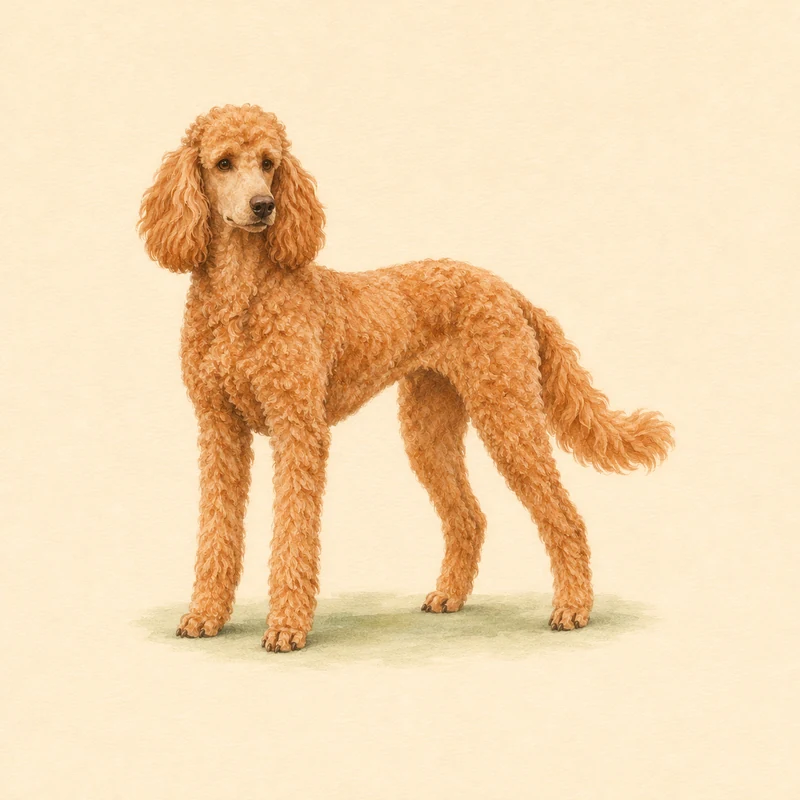
The Royal Kennel Club traces the Poodle to German water-retrieving dogs used by duck hunters. It recognises Standard, Miniature and Toy varieties by size. This article covers the Standard Poodle, not a combined health or exercise profile for all three varieties.
Read the evidence: Standard Poodle background and screening — Royal Kennel Club
Learn what engages this dog
The standard seeks a spirited, good-tempered dog. That does not promise effortless training or comfort in every setting. When meeting a Standard Poodle, ask about handling, relaxation and responses to unfamiliar people as well as favourite activities.
Editorial application, not a breed-specific trial or guaranteed behavioural outcome.
Read the evidence: Standard Poodle breed standard — Royal Kennel Club
Dense curls need a workable plan
The standard describes a profuse, dense coat with curly short hair. Discuss a practical trim with a groomer and the work it needs between visits. This guide makes no allergy-safety or zero-shedding promise.
Read the evidence: Standard Poodle breed standard — Royal Kennel Club
Teach one clear skill
Try rewarding a nose touch to your open hand in a quiet space. Keep practice short and voluntary; a reputation for intelligence is not a reason to rush.
Editorial application, not a breed-specific trial or guaranteed behavioural outcome.
Read the evidence: Reward-based training — Australian Veterinary Association
Match nutrition to life stage
Use complete life-stage food. Ask your vet about growth-appropriate feeding for your puppy rather than borrowing a plan written for a smaller Poodle variety.
Read the evidence: Evaluating Pet Food — NC State Veterinary Hospital
History is not an exercise prescription
Walks, sniffing and a gentle retrieve with a familiar toy can provide variety in a secure setting. Retrieving ancestry does not mean every dog enjoys water or strenuous sport. Build activities around this dog’s age, health and confidence.
Editorial application, not a breed-specific trial or guaranteed behavioural outcome.
Read the evidence: Standard Poodle background and screening — Royal Kennel Club
Reassess as needs change
Review portions against body condition and current activity. Health or appetite changes need individual advice, not a universal senior-Poodle feeding rule.
Read the evidence: Nutrition — Virginia Tech Veterinary Teaching Hospital
Use the Standard-specific screening list
The Royal Kennel Club’s Standard Poodle guidance lists eye and hip screening and DNA testing for von Willebrand disease type 1 among its best-practice checks. Ask your vet to interpret the full current list and actual records. These checks do not certify freedom from every disease and should not be silently replaced by another Poodle variety’s guidance.
Read the evidence: Standard Poodle background and screening — Royal Kennel Club
Prevent knots between appointments
Regular gentle coat care matters between professional visits. Check rubbing areas, including behind ears and under equipment. Get help with tight mats rather than cutting close to skin.
Read the evidence: Coat Care: Preventing Matted Hair — USDA APHIS
Plan drying as well as washing
Deal with tangles first, rinse carefully and dry thoroughly. Ask a groomer to demonstrate a routine that fits your dog’s coat length.
Read the evidence: Dog Grooming Tips — ASPCA · Standard Poodle breed standard — Royal Kennel Club
Choose a routine you can maintain
Set aside time for coat care and reward-based handling practice before it becomes urgent. A practical household plan should fit the dog and the people doing the work, rather than copying an elaborate show trim.
Editorial application, not a breed-specific trial or guaranteed behavioural outcome.
Read the evidence: Standard Poodle breed standard — Royal Kennel Club · Reward-based training — Australian Veterinary Association
Sources & scope
Source retrieval dates are recorded individually below. Written as general owner education by Good Dog; not clinically reviewed or endorsed by the organisations linked below. Breed standards describe ideals, not guarantees. Screening advice can change. These are selected considerations, not a complete list of conditions.
- Standard Poodle background and screening — Royal Kennel Club
Breed history and current screening signposts; activity context.
Limitations: Secondary historical account; screening guidance may change. No exercise quota, lifespan promise or popularity ranking adopted. Standard Poodle guidance is not applied to Toy or Miniature Poodles.
Source retrieved 2026-11-11 - Standard Poodle breed standard — Royal Kennel Club
Temperament ideals and coat description; not individual predictions.
Limitations: Show standard, not a temperament trial, health examination or disease survey. Poodle non-moulting wording is not adopted.
Publication or revision: April 2025
Source retrieved 2026-11-11 - Reward-based training — Australian Veterinary Association
Positive reinforcement and risks of pain/fear-based methods.
Limitations: General policy, not breed-specific efficacy evidence. Individual practice examples are editorial applications.
Publication or revision: 5 November 2021 ratification
Source retrieved 2026-11-11 - Evaluating Pet Food — NC State Veterinary Hospital
Complete life-stage nutrition and individual veterinary assessment.
Limitations: US label examples are not UK legal requirements. No product recommendations, recipes or transition schedule adopted.
Source retrieved 2026-11-11 - Nutrition — Virginia Tech Veterinary Teaching Hospital
Body condition, individual portions and review when appetite or health changes.
Limitations: No products, recipes, supplements or suggested waiting period for appetite loss adopted; US label advice not imposed on UK food.
Source retrieved 2026-11-11 - Coat Care: Preventing Matted Hair — USDA APHIS
Mat prevention and friction sites; pain and skin injury risk.
Limitations: Professional help rather than home cutting is a conservative editorial choice; no claim that the source prohibits all scissors.
Publication or revision: Issued October 2018; reviewed February 2024
Source retrieved 2026-11-11 - Dog Grooming Tips — ASPCA
Selected gentle brushing, bathing, fold drying and skin/eye referral guidance.
Limitations: Charity owner guidance with affiliate links. No fixed bathing interval, ear treatment, supplements or home scissors instructions adopted.
Source retrieved 2026-11-11