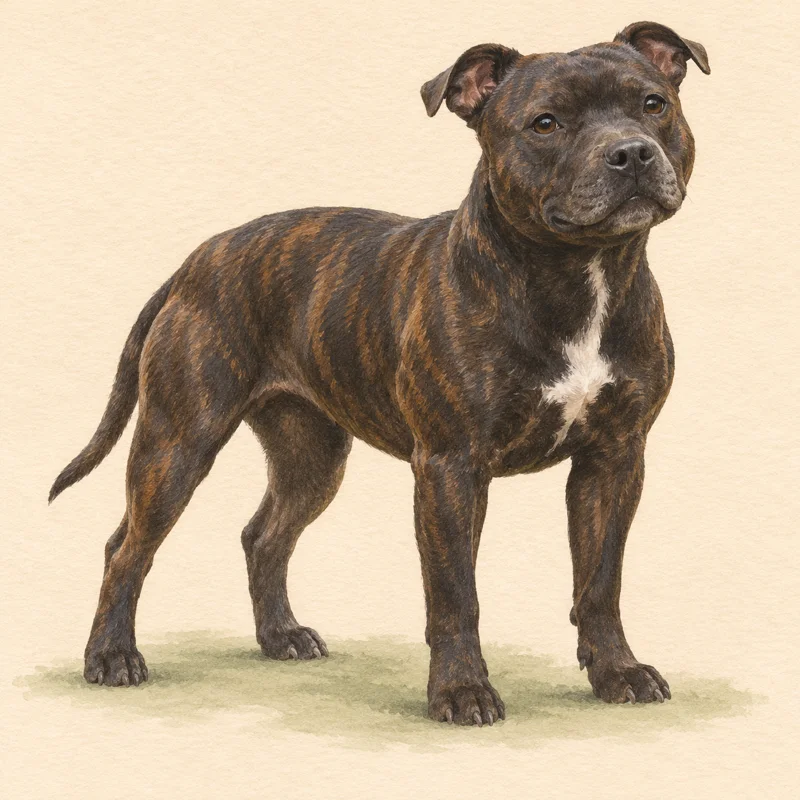
Origins and heritage
The Staffordshire Bull Terrier has bulldog and terrier ancestry, associated with the Black Country and historic blood sports. That history explains the name and development; it does not predict an individual pet’s behaviour.
Read the evidence: Staffordshire Bull Terrier: breed background — Royal Kennel Club
Personality, without promises
Breed descriptions emphasise an affectionate, lively companion. Individual comfort with people and dogs still varies. Supervise child–dog interactions and allow a quiet retreat; neither a friendly reputation nor a difficult history is a safety guarantee.
Read the evidence: Staffordshire Bull Terrier: breed standard — Royal Kennel Club
Understanding the coat
The recognised coat is short, close and smooth. It needs less detangling than a feathered coat, but skin checks still matter. A sparse-looking patch, persistent itch or redness is a reason to seek advice rather than scrub harder.
Read the evidence: Staffordshire Bull Terrier: breed standard — Royal Kennel Club
Learning for everyday life
Reward useful behaviour. Practise recall, loose-lead walking and relaxed handling in manageable steps.
Read the evidence: Reward-based training — Australian Veterinary Association
Food for the individual
Choose complete, life-stage-appropriate food; discuss body condition and any prescribed diet with your vet.
Read the evidence: Nutrition — Virginia Tech Veterinary Teaching Hospital
Movement with a purpose
Use breed history as context, not a daily exercise prescription. Let age, comfort, fitness and weather shape the plan. Your dog does not need to excel at their breed’s traditional job to have a fulfilling day.
Read the evidence: Staffordshire Bull Terrier: breed background — Royal Kennel Club
Puppy, adult and mature years
Young dogs: introduce experiences gently; stop when worried. Try settling beside you while visitors pass at a distance. Discuss safe socialisation with your vet.
All ages: choose safe activities your dog enjoys. An idea to try: choosing between two safe familiar toys. These are options, not breed requirements or a test of intelligence.
Mature dogs: adapt activities to ability with veterinary advice. For example, keep favourite play on a comfortable, non-slip surface. Keep companionship and enjoyable choices in their day.
Read the evidence: Puppy socialisation — UC Davis Veterinary Medicine · Environmental enrichment — Purdue Canine Welfare Science · Senior dog enrichment — Cornell University
Health conversations worth having
PDSA flags skin conditions, inherited eye problems and L-2-hydroxyglutaric aciduria among possible concerns. Ask a vet or breed health adviser which parental screening is relevant. Do not assume itching is a food allergy or change to a restrictive diet without advice.
Read the evidence: Staffordshire Bull Terrier health — PDSA
Brushing and cleaning
Use gentle strokes with a tool suited to a short coat. Let grooming double as a calm check for irritation and sore areas. There is no universal bath timetable: coat condition, skin health and veterinary advice should guide it.
Read the evidence: Staffordshire Bull Terrier: breed standard — Royal Kennel Club · Dog grooming tips — ASPCA
Keep care comfortable
Painful skin or severe matting needs professional help. Avoid cutting knots close to skin.
Do not insert cotton buds into ears. Ask your vet about pain, discharge or persistent odour.
Read the evidence: Coat care: preventing matted hair — USDA APHIS · How to clean your dog’s ears — Cornell University
Sources & scope
Source retrieval dates are recorded individually below. Written as general owner education by Good Dog; not clinically reviewed or endorsed by the organisations linked below. Breed standards describe ideals, not guarantees. Screening advice can change. These are selected considerations, not a complete list of conditions.
- Staffordshire Bull Terrier: breed background — Royal Kennel Club
Breed origins and broad activity context; not an individual exercise prescription.
Source retrieved 2026-11-10 - Staffordshire Bull Terrier: breed standard — Royal Kennel Club
Coat and temperament ideals; paraphrased, not guarantees about an individual.
Source retrieved 2026-11-10 - Reward-based training — Australian Veterinary Association
Positive reinforcement; avoid fear/pain-based training.
Source retrieved 2026-11-10 - Nutrition — Virginia Tech Veterinary Teaching Hospital
Life-stage complete diet, body condition and individual nutritional assessment.
Source retrieved 2026-11-10 - Puppy socialisation — UC Davis Veterinary Medicine
Brief positive experiences and gentle handling; veterinary vaccination context.
Source retrieved 2026-11-10 - Environmental enrichment — Purdue Canine Welfare Science
Individual preferences and safe activity at all ages. Specific suggested games are editorial applications, not breed requirements.
Source retrieved 2026-11-10 - Senior dog enrichment — Cornell University
Adapt activity to ability and discuss safe choices with a vet.
Source retrieved 2026-11-10 - Staffordshire Bull Terrier health — PDSA
Selected health concerns and screening discussions. No prevalence estimates or treatment advice adopted.
Source retrieved 2026-11-10 - Dog grooming tips — ASPCA
Gentle brushing by coat type, face cleaning and bathing. Older ear-cleaner advice not adopted; Cornell takes precedence.
Source retrieved 2026-11-10 - Coat care: preventing matted hair — USDA APHIS
Friction-area mats, variable grooming frequency and risks from matting or scissors.
Source retrieved 2026-11-10 - How to clean your dog’s ears — Cornell University
Avoid overcleaning and cotton buds; pain/odour requires veterinary advice.
Source retrieved 2026-11-10