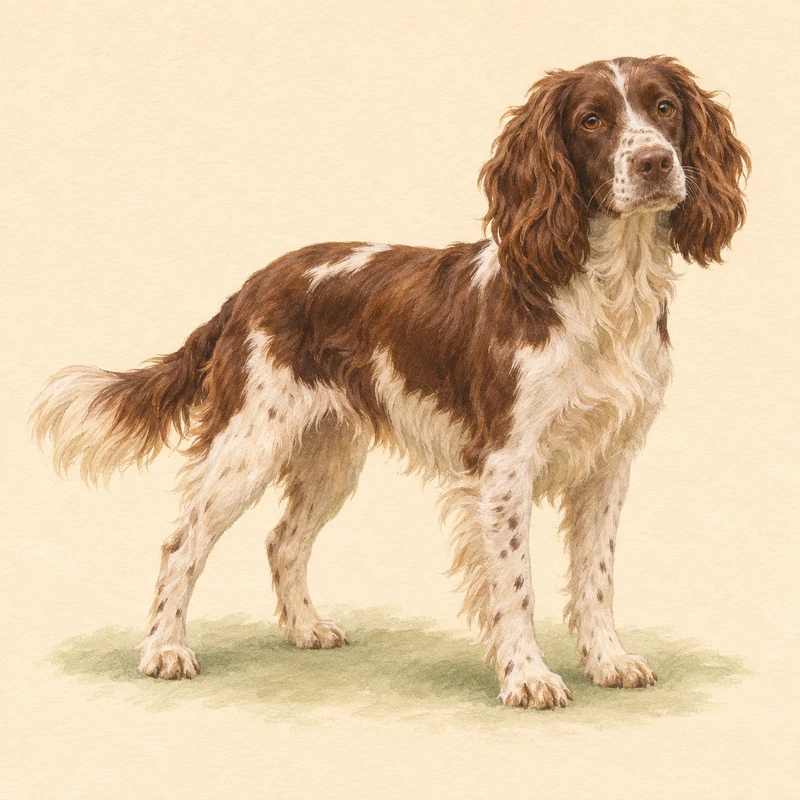
Two spaniel backgrounds
Sprocker is used for the Cocker Spaniel and English Springer Spaniel cross. Both parents have gundog histories. There is no verified single founding date in the sources used here, so this guide does not invent one.
Read the evidence: UK dog population estimation — Dogs Trust research preprint (2024) · Cocker Spaniel — Royal Kennel Club · English Springer Spaniel breed background — Royal Kennel Club
Family history is only a starting point
The Springer breed ideal describes a sociable, responsive dog. That is not a Sprocker temperament standard. Ask about both parents and observe the individual’s confidence and interests instead of promising an identical blend.
Read the evidence: English Springer Spaniel breed standard — Royal Kennel Club
Feathering needs attention
The Springer parent has weather-resistant hair with longer feathering on ears, legs and body. A Sprocker may inherit different density and length; this parent description cannot establish the exact coat layers of every cross. Ask a groomer to inspect the individual coat.
Read the evidence: English Springer Spaniel breed standard — Royal Kennel Club
Give searching a safe outlet
Reward recall and a calm exchange of toys. Try a simple search game; keep it easy enough to succeed.
Read the evidence: Reward-based training — Australian Veterinary Association
Food and portions
Choose complete life-stage food. Review portions, body condition and treats with your vet.
Read the evidence: Nutrition — Virginia Tech Veterinary Teaching Hospital
Expect more than a quick outing
Both parent breeds have active gundog backgrounds. As a practical starting point, make room for daily walking, sniffing and learning, then adjust to your dog. Do not average the parents’ exercise charts into a prescription for a puppy or older dog.
Read the evidence: Cocker Spaniel — Royal Kennel Club · English Springer Spaniel breed background — Royal Kennel Club
As your dog grows older
Growing puppies need growth-appropriate food; older dogs need individual dietary review, especially with illness.
Read the evidence: Nutrition — Virginia Tech Veterinary Teaching Hospital
Ask about both parents
A Sprocker does not bypass inherited concerns. Discuss both parents’ hip and eye screening and relevant DNA tests with your vet. Springer guidance also highlights ear infections. Parent-breed evidence flags questions to ask; it does not establish Sprocker disease rates.
Read the evidence: Cocker Spaniel — Royal Kennel Club · English Springer Spaniel breed background — Royal Kennel Club · English Springer Spaniel — PDSA
Check the hidden tangles
Inspect behind ears, armpits and collar areas gently. Dense mats need professional help; do not cut close to skin with scissors.
Read the evidence: Coat Care: Preventing Matted Hair — USDA APHIS
Bathing is separate from brushing
Use lukewarm water and suitable dog shampoo, then rinse thoroughly. Keep water and shampoo away from eyes and ears.
Read the evidence: Dog grooming tips — ASPCA
Comfort comes first
Avoid cotton buds. Pain, redness or unusual ear odour needs veterinary advice rather than more cleaning.
Read the evidence: How to clean your dog’s ears — Cornell University
Sources & scope
Source retrieval dates are recorded individually below. Written as general owner education by Good Dog; not clinically reviewed or endorsed by the organisations linked below. Breed standards describe ideals, not guarantees. Screening advice can change. These are selected considerations, not a complete list of conditions.
- UK dog population estimation — Dogs Trust research preprint (2024)
Historical UK population estimates and crossbreed definitions; not a 2026 popularity ranking.
Source retrieved 2026-11-11 - Cocker Spaniel — Royal Kennel Club
Parent-breed history/activity/screening only; no crossbreed prevalence inferred.
Source retrieved 2026-11-11 - English Springer Spaniel breed background — Royal Kennel Club
History, activity and current health screening; not a prescription.
Source retrieved 2026-11-11 - English Springer Spaniel breed standard — Royal Kennel Club
Coat and temperament ideals, not individual guarantees.
Source retrieved 2026-11-11 - Reward-based training — Australian Veterinary Association
Positive reinforcement and avoidance of aversive methods. Examples are editorial applications, not breed trials.
Source retrieved 2026-11-11 - Nutrition — Virginia Tech Veterinary Teaching Hospital
Complete life-stage food, individual portions and older-dog assessment. No US label wording prescribed for UK products.
Source retrieved 2026-11-11 - English Springer Spaniel — PDSA
Selected health cautions and everyday care; fixed schedules, prices and promotional material not adopted.
Source retrieved 2026-11-11 - Coat Care: Preventing Matted Hair — USDA APHIS
Friction-area matting, gentle prevention and professional help. No home scissor removal.
Source retrieved 2026-11-11 - Dog grooming tips — ASPCA
Lukewarm water, pet shampoo, rinsing and avoiding eyes/ears. Fixed bathing intervals and cotton-in-ear advice not adopted.
Source retrieved 2026-11-11 - How to clean your dog’s ears — Cornell University
No cotton buds; painful or inflamed ears require assessment rather than repeated cleaning.
Source retrieved 2026-11-11