Editorial context: practical handling ideas and questions are examples, not tested breed-specific outcomes or guarantees. Read the source scope and limitations below.
Training games and household examples are editorial applications. Health-screening items are selected current pre-breeding signposts, not a complete list of illnesses or an individual health assessment.
Siberian means a specific history
The Royal Kennel Club traces this sled-dog breed to northeast Siberia and the Chukchi people. This is the Siberian Husky guide, not a guide to the Alaskan Malamute or every dog described as an Alaskan husky. Working heritage is context, not an instruction to undertake endurance sport.
Editorial example based on the cited general guidance, not a breed-specific trial finding or individual prediction.
Read the evidence: Siberian Husky background and screening — Royal Kennel Club
An outgoing ideal still leaves room for individuality
The standard favours a friendly, gentle, alert dog and does not describe a guard-dog temperament. Meet the actual dog before deciding how it will cope with your household. An expressive face or striking eye colour is not a behaviour assessment.
Editorial example based on the cited general guidance, not a breed-specific trial finding or individual prediction.
Read the evidence: Siberian Husky standard — Royal Kennel Club
Two layers with a seasonal change
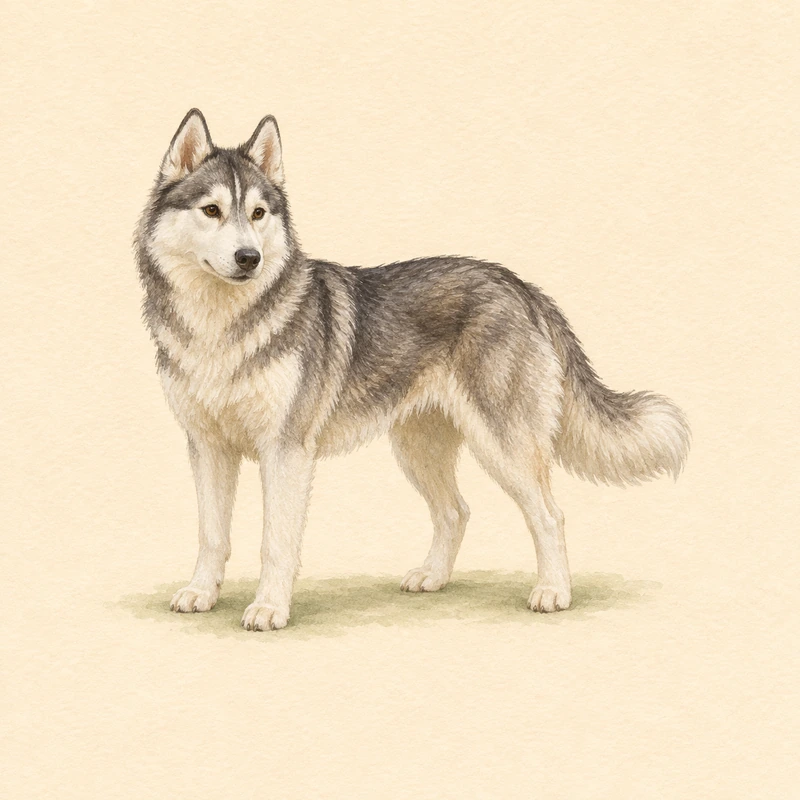
The breed standard describes a medium-length coat with a soft, dense undercoat supporting straighter outer guard hairs. It also notes that undercoat can be absent during shedding. That description explains normal coat variation; it does not establish that every patch of hair loss or skin change is harmless.
Editorial example based on the cited general guidance, not a breed-specific trial finding or individual prediction.
Read the evidence: Siberian Husky standard — Royal Kennel Club
Make a quiet check-in worthwhile
Reward a relaxed glance towards you before proceeding through a doorway. Begin in a low-distraction setting and keep the lead and environment secure. This small practice exercise applies reward-based principles without promising that training will remove every impulse to investigate.
Editorial example based on the cited general guidance, not a breed-specific trial finding or individual prediction.
Read the evidence: Reward-based dog training — Australian Veterinary Association
Feed the dog’s life, not a sled-team image
Use complete food suited to age and health, with portions reviewed for actual activity. A companion living in a warm home does not automatically need a working-dog ration because of its ancestry.
Editorial example based on the cited general guidance, not a breed-specific trial finding or individual prediction.
Read the evidence: Evaluating Pet Food — NC State Veterinary Hospital · Nutrition — Virginia Tech Veterinary Teaching Hospital
Plan around conditions as well as enthusiasm
PDSA warns that Huskies can overheat and advises avoiding the hottest part of the day. Choose cooler conditions and adapt activity to the dog’s fitness and comfort. An eager start is not a reason to keep extending a walk or to meet a fixed time quota.
Editorial example based on the cited general guidance, not a breed-specific trial finding or individual prediction.
Read the evidence: Siberian Husky care — PDSA
Revisit portions when activity changes
Review body condition when moving from puppyhood into adult routines or when later life becomes less active. Ask for veterinary advice about unexpected weight or appetite changes.
Inherit the specific scope and limitations of cited sources.
Read the evidence: Nutrition — Virginia Tech Veterinary Teaching Hospital
Eye and hip records answer different questions
The current Royal Kennel Club good-practice listing includes eye testing and gonioscopy for PLA. Hip testing appears under best practice. Ask a vet or breeder to explain each dated result; one normal result is not a substitute for the others or a lifetime guarantee.
Editorial example based on the cited general guidance, not a breed-specific trial finding or individual prediction.
Read the evidence: Siberian Husky background and screening — Royal Kennel Club
Expect loose undercoat
PDSA describes substantial shedding, with heavier seasonal shedding. Regular brushing helps manage it. Ask a groomer to demonstrate suitable tools and pressure rather than trying to remove all loose hair in one prolonged session.
Editorial example based on the cited general guidance, not a breed-specific trial finding or individual prediction.
Read the evidence: Siberian Husky care — PDSA
Consider the practical scale of the job
A dense-coated Husky can be awkward to bathe at home; PDSA suggests professional grooming as an option. Plan thorough rinsing and drying rather than leaving the job unfinished.
Editorial example based on the cited general guidance, not a breed-specific trial finding or individual prediction.
Read the evidence: Siberian Husky care — PDSA · Dog Grooming Tips — ASPCA
A thick coat does not cancel heat risk
Build a warm-weather plan before the day becomes hot: choose a cooler outing and a comfortable place to rest. Do not infer heat immunity from the coat. Ask a vet or groomer about a coat problem rather than treating show-standard trimming rules as medical instructions.
Editorial example based on the cited general guidance, not a breed-specific trial finding or individual prediction.
Read the evidence: Siberian Husky care — PDSA · Siberian Husky standard — Royal Kennel Club
Sources & scope
Source retrieval dates are recorded individually below. Written as general owner education by Good Dog; not clinically reviewed or endorsed by the organisations linked below. Breed standards describe ideals, not guarantees. Screening advice can change. These are selected considerations, not a complete list of conditions.
- Siberian Husky background and screening — Royal Kennel Club
Attributed history and current pre-breeding screening signposts.
Limitations: Secondary historical narrative; screening listings are time-sensitive and not an individual health guarantee. Fixed activity quotas and lifespan claims excluded.
Source retrieved 2026-11-11 - Siberian Husky standard — Royal Kennel Club
Temperament ideals and coat description.
Limitations: Conformation standard, not behaviour research or a clinical assessment. No working capacity or individual temperament guarantee adopted.
Publication or revision: 1 April 2025
Source retrieved 2026-11-11 - Reward-based dog training — Australian Veterinary Association
Positive reinforcement rather than pain or fear.
Limitations: General veterinary policy; the particular practice games in these guides are editorial examples, not tested breed-specific interventions.
Publication or revision: 5 November 2021 ratification
Source retrieved 2026-11-11 - Evaluating Pet Food — NC State Veterinary Hospital
Complete life-stage food and individual veterinary advice.
Limitations: US label examples are not UK regulation. Brands, recipes and transition percentages excluded.
Source retrieved 2026-11-11 - Nutrition — Virginia Tech Veterinary Teaching Hospital
Individual portions, life-stage review and appetite/weight changes.
Limitations: No suggested waiting period for appetite loss, recipes, supplement doses or US labelling requirements adopted.
Source retrieved 2026-11-11 - Siberian Husky care — PDSA
Shedding, heat precautions and practical grooming support.
Limitations: No fixed exercise quota, guaranteed social compatibility, cost estimate or claim of tirelessness adopted. Show-standard trimming rules are not clinical rules.
Source retrieved 2026-11-11 - Dog Grooming Tips — ASPCA
Gentle brushing, bathing, eye/ear water avoidance and drying.
Limitations: Charity page includes affiliate links. Fixed bath frequency, ear packing, eye lubricant and home cutting instructions excluded.
Source retrieved 2026-11-11