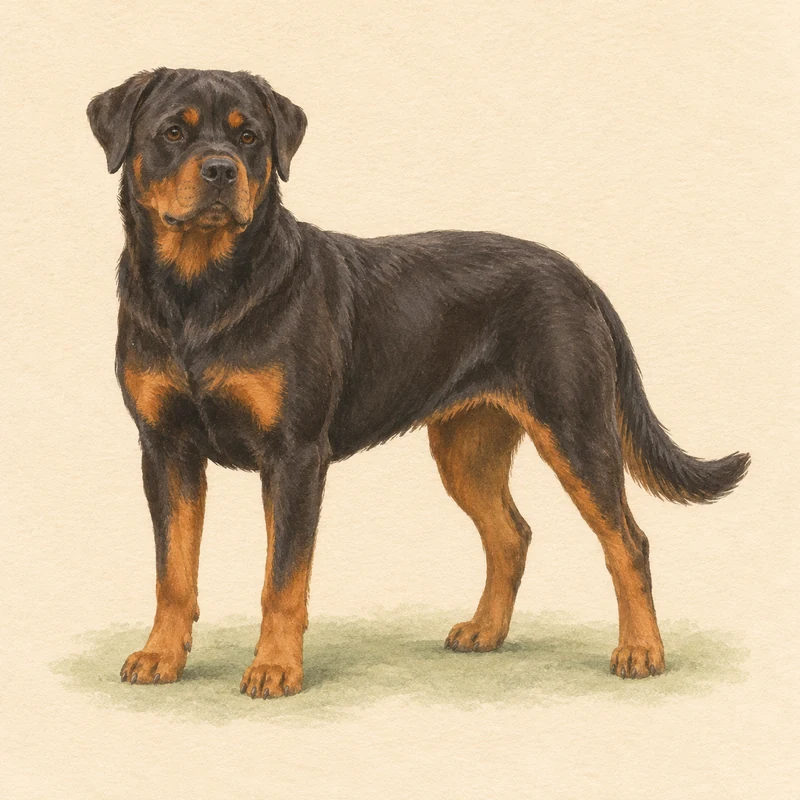
From cattle markets to companionship
The Rottweiler takes its name from Rottweil in south-west Germany, where cattle dealers and farmers developed a strong droving and guarding dog. That history explains its working background without deciding what any individual companion will be like.
Read the evidence: Rottweiler breed background and health screening — Royal Kennel Club
Look beyond both reputation and reassurance
The breed standard seeks a good-natured, responsive dog. It is not evidence that every Rottweiler is dangerous or automatically trustworthy. Ask about the dog’s actual behaviour around handling, visitors and other animals, and the support needed for a new home.
Read the evidence: Rottweiler breed standard — Royal Kennel Club
An undercoat beneath the outer layer
The standard describes a coarse, flat outer coat with an undercoat, particularly on the neck and thighs. The close outline can conceal more coat than a first glance suggests.
Read the evidence: Rottweiler breed standard — Royal Kennel Club
Make everyday handling cooperative
Use positive reinforcement rather than force. Practical priorities include calm lead walking, waiting at doors and comfortable handling. Choose one easy skill at a time and seek qualified help if fear or difficult behaviour makes practice unsafe.
Read the evidence: Reward-based training — Australian Veterinary Association
Complete food and an individual portion
Use complete food appropriate to life stage. Review portions and training rewards with your vet, aiming for a suitable body condition rather than maximum size.
Read the evidence: Rottweiler — PDSA
Movement and thinking time
Offer varied walks, play and thinking activities in secure surroundings. Build the routine around fitness, age and comfort instead of assuming every Rottweiler should do the same amount each day.
Read the evidence: Rottweiler — PDSA
Ask specifically about puppy growth
Discuss food suitable for a growing large-breed puppy with your vet. Adult and older-dog feeding should then be reviewed against the individual’s life stage and health.
Read the evidence: Evaluating Pet Food — NC State Veterinary Hospital
Ask for the records, not a reassurance
The current Royal Kennel Club guidance lists hip and elbow screening and a DNA test for juvenile laryngeal paralysis and polyneuropathy under good practice. Further tests are listed under best practice. Ask your vet to explain the records and their limits; screening does not guarantee a puppy will remain healthy.
Read the evidence: Rottweiler breed background and health screening — Royal Kennel Club
Work with the coat you can feel
Regular brushing removes loose hair; more may be needed during seasonal shedding. Work gently through the coat rather than pressing harder because the dog is large.
Read the evidence: Rottweiler — PDSA
Dry beyond the surface
After bathing, dry thoroughly rather than leaving the undercoat damp. Keep water away from the ears.
Read the evidence: Dog Grooming Tips — ASPCA · Rottweiler breed standard — Royal Kennel Club
Plan supervision and space
Supervise interactions with children and vulnerable adults, and give the dog a place to withdraw. Agree who handles the lead and how visitors are introduced. These practical choices matter more than assuming either safety or danger from the breed name.
Read the evidence: Rottweiler — PDSA
Sources & scope
Source retrieval dates are recorded individually below. Written as general owner education by Good Dog; not clinically reviewed or endorsed by the organisations linked below. Breed standards describe ideals, not guarantees. Screening advice can change. These are selected considerations, not a complete list of conditions.
- Rottweiler breed background and health screening — Royal Kennel Club
Historical background and listed screening; broad activity context.
Source retrieved 2026-11-11 - Rottweiler breed standard — Royal Kennel Club
Coat and temperament ideal; physical description.
Source retrieved 2026-11-11 - Reward-based training — Australian Veterinary Association
Positive reinforcement and avoiding fear/pain-based training.
Source retrieved 2026-11-11 - Rottweiler — PDSA
Selected exercise, grooming and supervised-interaction guidance.
Source retrieved 2026-11-11 - Evaluating Pet Food — NC State Veterinary Hospital
Complete life-stage food and individual veterinary advice.
Source retrieved 2026-11-11 - Dog Grooming Tips — ASPCA
Selected bathing, brushing, fold drying and eye/ear warning advice.
Source retrieved 2026-11-11