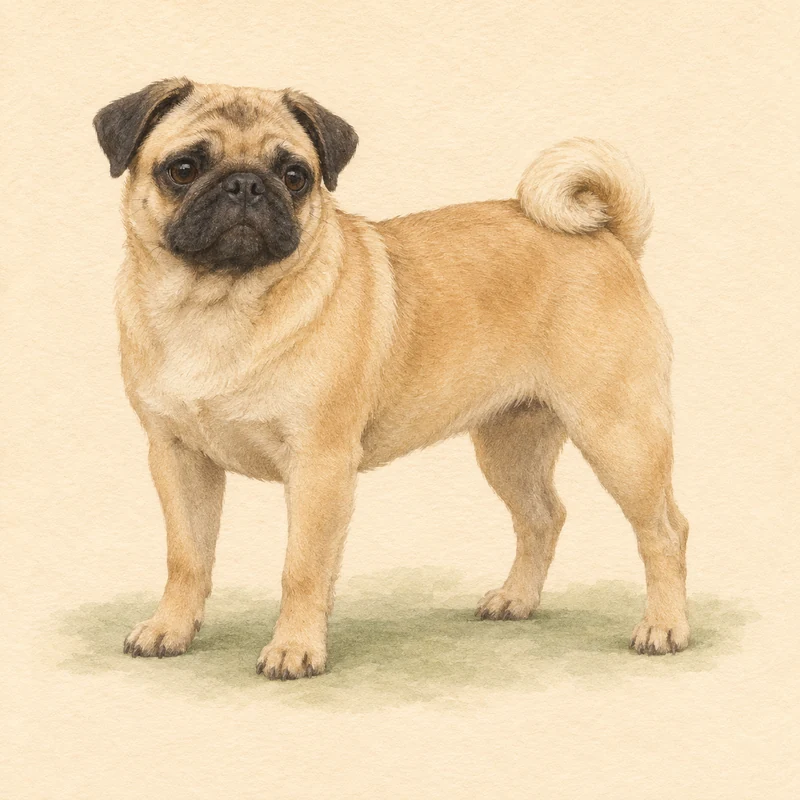
Companion history, present-day welfare
The Royal Kennel Club describes a Chinese origin and an early route into Europe through Dutch trade. That historical account explains the breed’s companion background; it does not make an exaggerated face shape harmless today.
Read the evidence: Pug breed background and health screening — Royal Kennel Club
Meet the dog, not the caricature
The breed standard calls for a happy, lively, even temperament. These are desired traits rather than evidence that every Pug enjoys every person, pet or activity. Ask about the individual’s routines and reactions.
Read the evidence: Pug breed standard — Royal Kennel Club
Short coat, separate fold care
The standard describes short, fine, smooth hair. Facial folds need attention separately from coat brushing; the amount of hair does not tell the whole care story.
Read the evidence: Pug breed standard — Royal Kennel Club · Dog Grooming Tips — ASPCA
Reward learning without pressure
Use positive reinforcement. As a practical starting point, reward settling in a comfortable place and brief cooperative handling. Keep the task easy enough that you can stop calmly rather than using force to finish.
Read the evidence: Reward-based training — Australian Veterinary Association
Keep completeness and portions distinct
Choose complete life-stage food. Review body condition and portions with your vet, counting food used for rewards as part of the day’s intake.
Read the evidence: Nutrition — Virginia Tech Veterinary Teaching Hospital
Comfort comes before a target
Avoid exertion in hot conditions. Choose comfortable, gentle activity and stop if breathing becomes difficult. Struggling to breathe needs immediate veterinary contact, not encouragement to finish a walk. No fixed walking quota suits every Pug.
Read the evidence: BOAS: breathing problems in flat-faced dogs — PDSA
Health can change the food plan
Growing puppies need growth-appropriate nutrition. As your Pug matures, ask your vet to review food against current health and life stage, rather than continuing a puppy diet automatically.
Read the evidence: Evaluating Pet Food — NC State Veterinary Hospital
Take breathing and eye health seriously
A 2022 study using UK veterinary records from 2016 found higher adjusted odds of brachycephalic obstructive airway syndrome (BOAS) and corneal ulceration in Pugs than non-Pugs. It does not predict one dog’s health. Ask about parent breathing assessments and eye screening; low breathing grades do not guarantee a healthy puppy.
Read the evidence: Health of Pug dogs in the UK: disorder predispositions and protections · Pug breed background and health screening — Royal Kennel Club · BOAS: breathing problems in flat-faced dogs — PDSA
Brush the coat, inspect the folds
Gentle coat brushing is distinct from fold care. For surface dirt, clean folds gently with a damp cloth and dry them thoroughly. Sore or persistently irritated skin needs veterinary advice.
Read the evidence: Dog Grooming Tips — ASPCA
Protect the face
Keep bath water and cleansing products away from the eyes and nose. Dry the skin folds carefully afterwards.
Read the evidence: Dog Grooming Tips — ASPCA
Know when to seek help
Do not dismiss noisy breathing or disturbed sleep as a funny breed trait: arrange a veterinary assessment. Sudden or severe breathing difficulty, collapse or blue-coloured gums are emergencies. Contact a vet immediately. These signs do not establish a diagnosis; do not try an exercise test at home.
Read the evidence: BOAS: breathing problems in flat-faced dogs — PDSA
Sources & scope
Source retrieval dates are recorded individually below. Written as general owner education by Good Dog; not clinically reviewed or endorsed by the organisations linked below. Breed standards describe ideals, not guarantees. Screening advice can change. These are selected considerations, not a complete list of conditions.
- Pug breed background and health screening — Royal Kennel Club
Historical background and listed screening; broad activity context.
Source retrieved 2026-11-11 - Pug breed standard — Royal Kennel Club
Coat and temperament ideal; physical description.
Source retrieved 2026-11-11 - Dog Grooming Tips — ASPCA
Selected bathing, brushing, fold drying and eye/ear warning advice.
Source retrieved 2026-11-11 - Reward-based training — Australian Veterinary Association
Positive reinforcement and avoiding fear/pain-based training.
Source retrieved 2026-11-11 - Nutrition — Virginia Tech Veterinary Teaching Hospital
Body condition, portions, treats and life-stage dietary review.
Source retrieved 2026-11-11 - BOAS: breathing problems in flat-faced dogs — PDSA
Breathing warning signs, urgent referral, heat/exercise caution and screening limitations.
Source retrieved 2026-11-11 - Evaluating Pet Food — NC State Veterinary Hospital
Complete life-stage food and individual veterinary advice.
Source retrieved 2026-11-11 - Health of Pug dogs in the UK: disorder predispositions and protections
Higher adjusted odds of BOAS and corneal ulceration in Pugs versus non-Pugs.
Source retrieved 2026-11-11