Editorial context: practical handling ideas and questions are examples, not tested breed-specific outcomes or guarantees. Read the source scope and limitations below.
Training games and household examples are editorial applications. Health-screening items are selected current pre-breeding signposts, not a complete list of illnesses or an individual health assessment.
Miniature is a defined variety
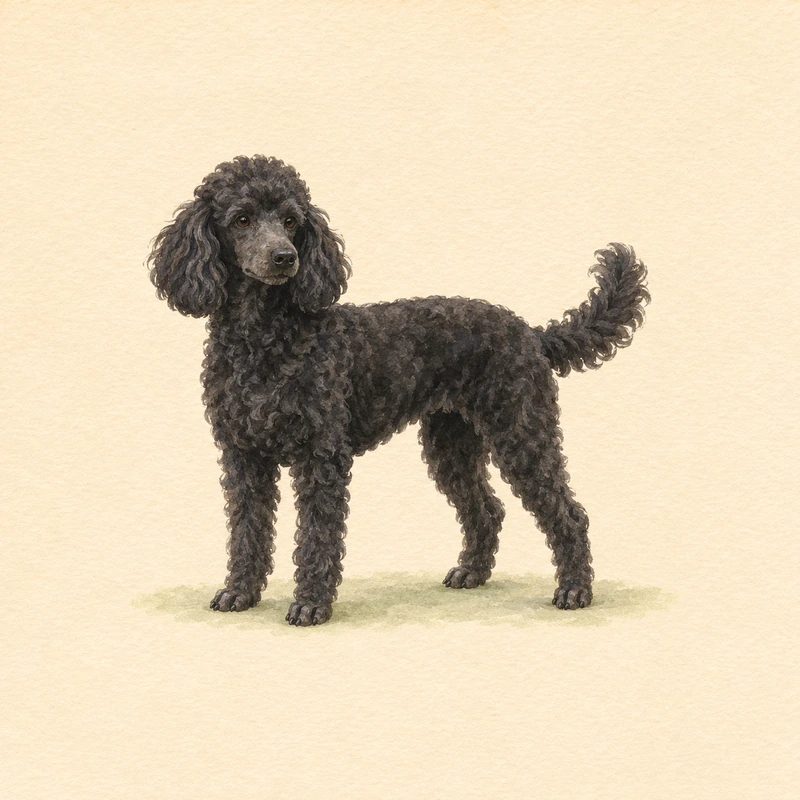
The Royal Kennel Club traces Poodles to German water retrievers and recognises three size varieties. Its Miniature standard specifies a shoulder height of at least 28 cm and below 38 cm, while warning that individuals can fall outside standard measurements. This guide is for Miniature Poodles, not Standard or Toy Poodles.
Inherit the specific scope and limitations of cited sources.
Read the evidence: Poodle Miniature background and screening — Royal Kennel Club · Poodle Miniature standard — Royal Kennel Club
A good-tempered ideal is a starting point
The standard describes a good-tempered, spirited ideal. Ask about the dog’s daily experiences and response to unfamiliar handling. A reputation for intelligence does not tell you which tasks this individual knows or how comfortable it is in a busy home.
Editorial example based on the cited general guidance, not a breed-specific trial finding or individual prediction.
Read the evidence: Poodle Miniature standard — Royal Kennel Club
Curls need a workable plan
The standard describes profuse, dense hair with a harsh texture and tight curls in short hair. A dramatic trim is not a household requirement. Discuss a style and upkeep routine you can maintain; the amount of hair left between visits changes the practical work.
Editorial example based on the cited general guidance, not a breed-specific trial finding or individual prediction.
Read the evidence: Poodle Miniature standard — Royal Kennel Club · Coat Care: Preventing Matted Hair — USDA APHIS
Teach a small cooperative step
Reward the dog for placing its chin briefly on your open hand, without holding it there. Keep the interaction optional and stop before frustration. This is an editorial cooperative-handling idea, not a breed-specific technique or a substitute for help with painful grooming.
Editorial example based on the cited general guidance, not a breed-specific trial finding or individual prediction.
Read the evidence: Reward-based dog training — Australian Veterinary Association
Do not scale another Poodle’s bowl by eye
Choose complete life-stage food and review the individual’s portion. Being smaller than a Standard Poodle is not a feeding formula; condition and activity matter more than a visual comparison between varieties.
Editorial example based on the cited general guidance, not a breed-specific trial finding or individual prediction.
Read the evidence: Evaluating Pet Food — NC State Veterinary Hospital · Nutrition — Virginia Tech Veterinary Teaching Hospital
Give the mind and body choices
Try a relaxed walk with sniffing opportunities or a simple search for a familiar toy in a safe room. These are adaptable suggestions, not proof of one ideal Poodle routine. Judge whether the dog is comfortable and engaged, not whether it completes a set quota.
Editorial example based on the cited general guidance, not a breed-specific trial finding or individual prediction.
Read the evidence: Poodle Miniature background and screening — Royal Kennel Club
Account for rewards and changing routines
Include training rewards when discussing total food intake. During growth and later changes in activity, reassess the feeding plan with your vet rather than relying indefinitely on the first portion you used.
Editorial example based on the cited general guidance, not a breed-specific trial finding or individual prediction.
Read the evidence: Nutrition — Virginia Tech Veterinary Teaching Hospital
Use the Miniature screening list
The current Miniature page lists DNA tests for osteochondrodysplasia (OC) and prcd-PRA, plus eye and hip testing, under best practice. These are Miniature-specific signposts from that page, not a list copied from Standard or Toy Poodles. Ask what each result covers and remember that screening cannot rule out all future illness.
Editorial example based on the cited general guidance, not a breed-specific trial finding or individual prediction.
Read the evidence: Poodle Miniature background and screening — Royal Kennel Club
Check the roots, not only the outline
Give attention to hair behind ears and where the harness rubs. Mats can be painful even when the outer style looks neat. Seek professional help for tight tangles; do not work scissors close to skin.
Editorial example based on the cited general guidance, not a breed-specific trial finding or individual prediction.
Read the evidence: Coat Care: Preventing Matted Hair — USDA APHIS
Prepare for drying as well as washing
Resolve difficult tangles with help before bathing. Rinse thoroughly and dry carefully; a clean-looking surface is not the whole job in a dense coat.
Editorial example based on the cited general guidance, not a breed-specific trial finding or individual prediction.
Read the evidence: Dog Grooming Tips — ASPCA · Coat Care: Preventing Matted Hair — USDA APHIS
Make maintenance realistic
Budget time for between-appointment checks as well as professional grooming. If coat care is becoming a struggle, ask about a simpler style and handling support. A practical trim still needs attention, but an elaborate one should never come before the dog’s comfort.
Editorial example based on the cited general guidance, not a breed-specific trial finding or individual prediction.
Read the evidence: Coat Care: Preventing Matted Hair — USDA APHIS · Reward-based dog training — Australian Veterinary Association
Sources & scope
Source retrieval dates are recorded individually below. Written as general owner education by Good Dog; not clinically reviewed or endorsed by the organisations linked below. Breed standards describe ideals, not guarantees. Screening advice can change. These are selected considerations, not a complete list of conditions.
- Poodle Miniature background and screening — Royal Kennel Club
Attributed history and current pre-breeding screening signposts.
Limitations: Secondary historical narrative; screening listings are time-sensitive and not an individual health guarantee. Fixed activity quotas and lifespan claims excluded. Only the Miniature listing is used, not Standard or Toy screening.
Source retrieved 2026-11-11 - Poodle Miniature standard — Royal Kennel Club
Temperament ideals, coat description and Miniature size boundary.
Limitations: Conformation standard, not behaviour research or a clinical assessment. No claim of non-moulting or allergy safety adopted.
Publication or revision: April 2025
Source retrieved 2026-11-11 - Coat Care: Preventing Matted Hair — USDA APHIS
Friction sites, mat discomfort and injury risk.
Limitations: Professional removal of tight mats is conservative editorial advice; the source itself discusses scissors and clippers, not a ban.
Publication or revision: Issued October 2018; reviewed February 2024
Source retrieved 2026-11-11 - Reward-based dog training — Australian Veterinary Association
Positive reinforcement rather than pain or fear.
Limitations: General veterinary policy; the particular practice games in these guides are editorial examples, not tested breed-specific interventions.
Publication or revision: 5 November 2021 ratification
Source retrieved 2026-11-11 - Evaluating Pet Food — NC State Veterinary Hospital
Complete life-stage food and individual veterinary advice.
Limitations: US label examples are not UK regulation. Brands, recipes and transition percentages excluded.
Source retrieved 2026-11-11 - Nutrition — Virginia Tech Veterinary Teaching Hospital
Individual portions, life-stage review and appetite/weight changes.
Limitations: No suggested waiting period for appetite loss, recipes, supplement doses or US labelling requirements adopted.
Source retrieved 2026-11-11 - Dog Grooming Tips — ASPCA
Gentle brushing, bathing, eye/ear water avoidance and drying.
Limitations: Charity page includes affiliate links. Fixed bath frequency, ear packing, eye lubricant and home cutting instructions excluded.
Source retrieved 2026-11-11