Editorial context: practical handling ideas and questions are examples, not tested breed-specific outcomes or guarantees. Read the source scope and limitations below.
Training games and household examples are editorial applications. Health-screening items are selected current pre-breeding signposts, not a complete list of illnesses or an individual health assessment.
A Mediterranean companion story
The Royal Kennel Club describes small white companion dogs around the Mediterranean as the Maltese’s ancestry. Its account treats transport to Malta by Phoenician traders as a suggestion, not an established fact. The breed’s historical association with Malta does not make every colourful origin story certain.
Inherit the specific scope and limitations of cited sources.
Read the evidence: Maltese background and screening — Royal Kennel Club
Small does not mean endlessly available
The standard seeks a lively, alert dog with a sweet temperament. That is an ideal, not permission to pass a dog from person to person. Let the individual choose whether to approach, and discuss handling experience with the breeder or rescue.
Editorial example based on the cited general guidance, not a breed-specific trial finding or individual prediction.
Read the evidence: Maltese standard — Royal Kennel Club
Silk that should allow movement
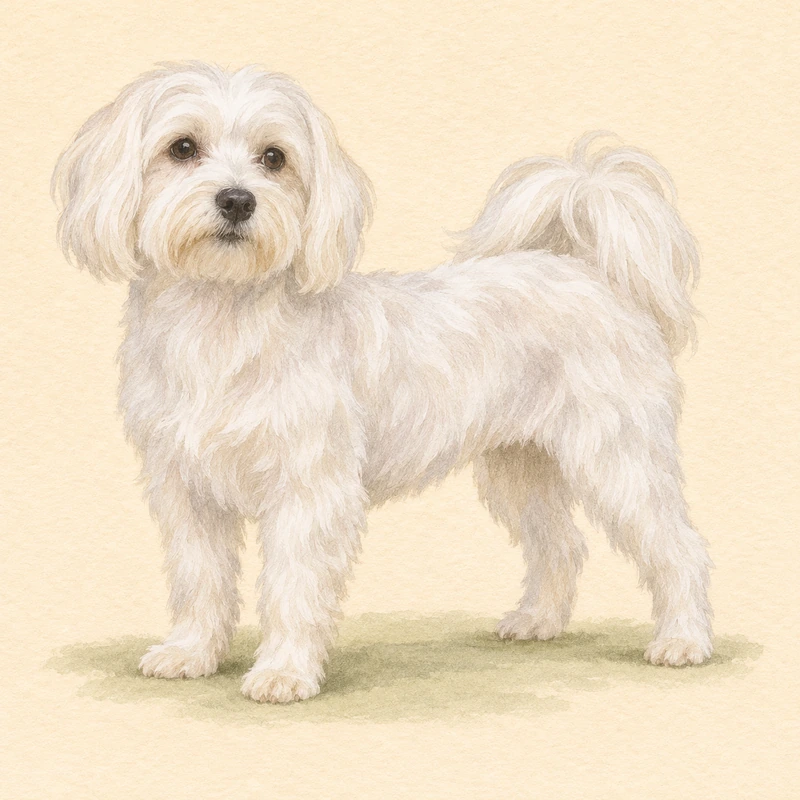
The standard describes straight, silky hair without a woolly undercoat and explicitly says length should not impede movement. A practical household trim can be discussed with a groomer. The goal is a comfortable dog, not preserving every centimetre of hair.
Editorial example based on the cited general guidance, not a breed-specific trial finding or individual prediction.
Read the evidence: Maltese standard — Royal Kennel Club
Build a voluntary grooming station
Place a mat on a stable surface at floor level and reward the dog for approaching it. Later, practise a brief, comfortable brush touch followed by a break. The mat is an editorial training idea, not a promise that all Maltese enjoy grooming.
Editorial example based on the cited general guidance, not a breed-specific trial finding or individual prediction.
Read the evidence: Reward-based dog training — Australian Veterinary Association
Keep the main meal nutritionally complete
Select complete food for the appropriate life stage. Ask your vet about feeding difficulties rather than replacing meals with a growing assortment of extras. A small body still needs a balanced daily diet.
Editorial example based on the cited general guidance, not a breed-specific trial finding or individual prediction.
Read the evidence: Evaluating Pet Food — NC State Veterinary Hospital
Offer choices beyond being carried
Give a comfortable Maltese opportunities to walk, sniff and investigate at its own pace. A gentle search for a toy indoors can vary the day. Adjust outings to the individual rather than assuming a toy-breed label means no exercise or exploration is needed.
Editorial example based on the cited general guidance, not a breed-specific trial finding or individual prediction.
Read the evidence: Maltese background and screening — Royal Kennel Club
Notice changes in eating
Keep track of appetite and weight through growth and adulthood. New reluctance to eat deserves veterinary advice rather than being accepted as a permanent personality trait.
Editorial example based on the cited general guidance, not a breed-specific trial finding or individual prediction.
Read the evidence: Nutrition — Virginia Tech Veterinary Teaching Hospital
Eye checks are more than appearance
Current Royal Kennel Club best-practice guidance lists eye testing through the BVA/KC/ISDS scheme. Ask for dated records and what they cover. A tidy face or an attractive dark eye cannot substitute for examination, and a screening record does not predict every future problem.
Editorial example based on the cited general guidance, not a breed-specific trial finding or individual prediction.
Read the evidence: Maltese background and screening — Royal Kennel Club
Prevent knots where hair rubs
Check behind the ears and beneath the harness when grooming. Work gently; tight mats can hurt and may hide irritated skin. Ask a professional to remove difficult mats rather than cutting close to skin.
Editorial example based on the cited general guidance, not a breed-specific trial finding or individual prediction.
Read the evidence: Coat Care: Preventing Matted Hair — USDA APHIS
Prepare the coat before the bath
Deal with tangles before wetting the hair. Protect eyes and ears from the water stream, rinse carefully and dry the coat thoroughly.
Inherit the specific scope and limitations of cited sources.
Read the evidence: Dog Grooming Tips — ASPCA
Choose upkeep you can sustain
Plan who will check the coat between grooming appointments. If long hair repeatedly tangles or obstructs easy movement, ask about a more manageable style. Comfort, visibility and willingness to be handled are more useful household goals than an immaculate show outline.
Editorial example based on the cited general guidance, not a breed-specific trial finding or individual prediction.
Read the evidence: Maltese standard — Royal Kennel Club · Coat Care: Preventing Matted Hair — USDA APHIS
Sources & scope
Source retrieval dates are recorded individually below. Written as general owner education by Good Dog; not clinically reviewed or endorsed by the organisations linked below. Breed standards describe ideals, not guarantees. Screening advice can change. These are selected considerations, not a complete list of conditions.
- Maltese background and screening — Royal Kennel Club
Attributed history and current pre-breeding screening signposts.
Limitations: Secondary historical narrative; screening listings are time-sensitive and not an individual health guarantee. Fixed activity quotas and lifespan claims excluded.
Source retrieved 2026-11-11 - Maltese standard — Royal Kennel Club
Temperament ideals and coat description.
Limitations: Conformation standard, not behaviour research or a clinical assessment. No working capacity or individual temperament guarantee adopted.
Publication or revision: April 2025
Source retrieved 2026-11-11 - Reward-based dog training — Australian Veterinary Association
Positive reinforcement rather than pain or fear.
Limitations: General veterinary policy; the particular practice games in these guides are editorial examples, not tested breed-specific interventions.
Publication or revision: 5 November 2021 ratification
Source retrieved 2026-11-11 - Evaluating Pet Food — NC State Veterinary Hospital
Complete life-stage food and individual veterinary advice.
Limitations: US label examples are not UK regulation. Brands, recipes and transition percentages excluded.
Source retrieved 2026-11-11 - Nutrition — Virginia Tech Veterinary Teaching Hospital
Individual portions, life-stage review and appetite/weight changes.
Limitations: No suggested waiting period for appetite loss, recipes, supplement doses or US labelling requirements adopted.
Source retrieved 2026-11-11 - Coat Care: Preventing Matted Hair — USDA APHIS
Friction sites, mat discomfort and injury risk.
Limitations: Professional removal of tight mats is conservative editorial advice; the source itself discusses scissors and clippers, not a ban.
Publication or revision: Issued October 2018; reviewed February 2024
Source retrieved 2026-11-11 - Dog Grooming Tips — ASPCA
Gentle brushing, bathing, eye/ear water avoidance and drying.
Limitations: Charity page includes affiliate links. Fixed bath frequency, ear packing, eye lubricant and home cutting instructions excluded.
Source retrieved 2026-11-11