Editorial context: practical handling ideas and questions are examples, not tested breed-specific outcomes or guarantees. Read the source scope and limitations below.
Companionship in Tibet
The Royal Kennel Club describes Lhasa Apsos as companions and watchdogs in Tibetan monasteries. Its history records their separation from the Tibetan Terrier classification in 1934. A watchdog background is context, not proof that an individual dog will react in a particular way to visitors.
Read the evidence: Lhasa Apso background and screening — Royal Kennel Club
Give introductions time
The standard describes an alert, steady dog that can be reserved with strangers. Respect the individual’s pace rather than insisting on immediate contact. Ask what helps the dog feel comfortable in a new place.
Editorial application, not a breed-specific trial or guaranteed behavioural outcome.
Read the evidence: Lhasa Apso breed standard — Royal Kennel Club
Length must not get in the way
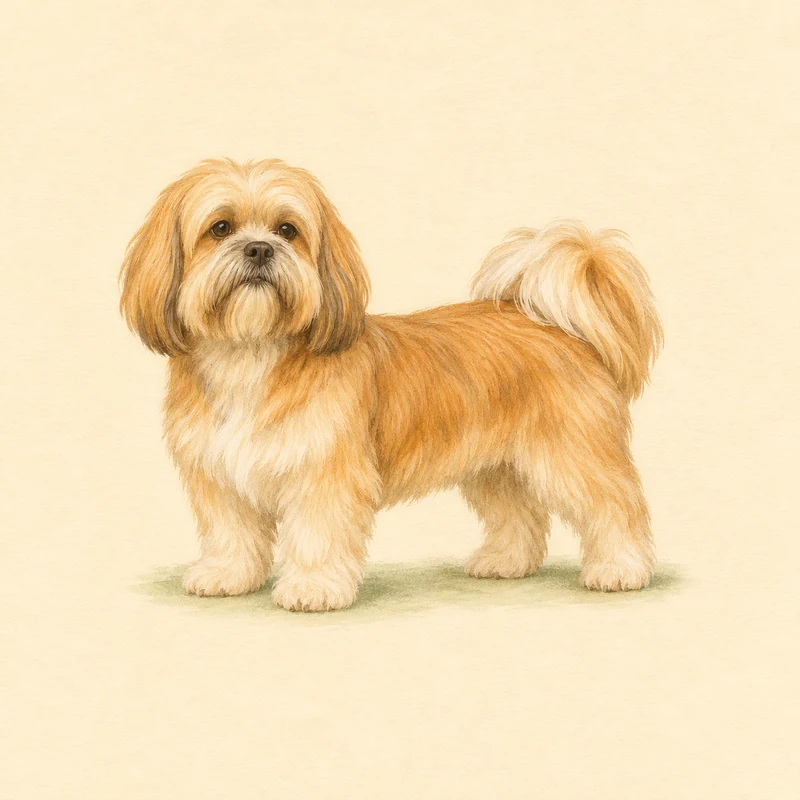
The standard describes a long, straight outer coat with a moderate undercoat, and says coat should not impede movement. Choose upkeep that keeps your dog comfortable; hair should not obstruct seeing or moving freely.
Read the evidence: Lhasa Apso breed standard — Royal Kennel Club
Build trust around grooming
Reward approaching the grooming area and taking a comfortable pause. Let the dog move away between easy steps instead of forcing a long session.
Editorial application, not a breed-specific trial or guaranteed behavioural outcome.
Read the evidence: Reward-based training — Australian Veterinary Association
Keep the feeding decision individual
Choose complete food suited to life stage. Review any health-related dietary needs with your vet rather than treating a long coat as a special nutritional diagnosis.
Read the evidence: Evaluating Pet Food — NC State Veterinary Hospital
Make room for quiet exploration
A gentle walk and an easy toy-search game are useful options to discuss when planning the day. Adjust to age, fitness and comfort. Stop rather than pushing to meet a breed exercise target, and ask your vet about persistent noisy breathing. Struggling to breathe or collapse requires immediate emergency veterinary care.
Editorial application, not a breed-specific trial or guaranteed behavioural outcome.
Read the evidence: Lhasa Apso background and screening — Royal Kennel Club · Brachycephalic Obstructive Airway Syndrome — Cornell University College of Veterinary Medicine
Watch appetite and condition
Revisit portions when activity changes. Ask your vet about unexplained appetite or weight changes rather than assuming the dog has become a fussy eater with age.
Read the evidence: Nutrition — Virginia Tech Veterinary Teaching Hospital
Ask what the eye tests cover
Current Royal Kennel Club guidance lists a DNA test for progressive retinal atrophy (PRA4) under good practice and eye examination under best practice. Ask for dated results and a veterinary explanation of their scope. Neither one genetic result nor a clear examination guarantees lifelong eye health.
Read the evidence: Lhasa Apso background and screening — Royal Kennel Club
Reach the places that rub
Regular grooming helps prevent painful mats. Check behind ears and under collars or harnesses; seek professional help if knots are close to skin.
Read the evidence: Coat Care: Preventing Matted Hair — USDA APHIS
Rinse and dry with care
Avoid directing water into eyes, nose or ears. Rinse well and dry thoroughly rather than leaving the longer coat damp.
Read the evidence: Dog Grooming Tips — ASPCA
Separate appearance from comfort
Cornell includes Lhasa Apsos among breeds that can be affected by brachycephalic obstructive airway syndrome (BOAS). A breed name or attractive outline cannot diagnose or exclude it. Persistent noisy breathing needs assessment; struggling to breathe or collapsing calls for immediate emergency veterinary care.
Read the evidence: Brachycephalic Obstructive Airway Syndrome — Cornell University College of Veterinary Medicine
Sources & scope
Source retrieval dates are recorded individually below. Written as general owner education by Good Dog; not clinically reviewed or endorsed by the organisations linked below. Breed standards describe ideals, not guarantees. Screening advice can change. These are selected considerations, not a complete list of conditions.
- Lhasa Apso background and screening — Royal Kennel Club
Breed history and current screening signposts; activity context.
Limitations: Secondary historical account; screening guidance may change. No exercise quota, lifespan promise or popularity ranking adopted.
Source retrieved 2026-11-11 - Lhasa Apso breed standard — Royal Kennel Club
Temperament ideals and coat description; not individual predictions.
Limitations: Show standard, not a temperament trial, health examination or disease survey.
Publication or revision: 1 August 2025
Source retrieved 2026-11-11 - Reward-based training — Australian Veterinary Association
Positive reinforcement and risks of pain/fear-based methods.
Limitations: General policy, not breed-specific efficacy evidence. Individual practice examples are editorial applications.
Publication or revision: 5 November 2021 ratification
Source retrieved 2026-11-11 - Evaluating Pet Food — NC State Veterinary Hospital
Complete life-stage nutrition and individual veterinary assessment.
Limitations: US label examples are not UK legal requirements. No product recommendations, recipes or transition schedule adopted.
Source retrieved 2026-11-11 - Brachycephalic Obstructive Airway Syndrome — Cornell University College of Veterinary Medicine
English Bulldog and Lhasa Apso inclusion; signs, heat caution, urgent respiratory-crisis referral.
Limitations: Clinical owner education, not diagnosis or prevalence research. No treatment, surgery, home test or individual prognosis adopted.
Source retrieved 2026-11-11 - Nutrition — Virginia Tech Veterinary Teaching Hospital
Body condition, individual portions and review when appetite or health changes.
Limitations: No products, recipes, supplements or suggested waiting period for appetite loss adopted; US label advice not imposed on UK food.
Source retrieved 2026-11-11 - Coat Care: Preventing Matted Hair — USDA APHIS
Mat prevention and friction sites; pain and skin injury risk.
Limitations: Professional help rather than home cutting is a conservative editorial choice; no claim that the source prohibits all scissors.
Publication or revision: Issued October 2018; reviewed February 2024
Source retrieved 2026-11-11 - Dog Grooming Tips — ASPCA
Selected gentle brushing, bathing, fold drying and skin/eye referral guidance.
Limitations: Charity owner guidance with affiliate links. No fixed bathing interval, ear treatment, supplements or home scissors instructions adopted.
Source retrieved 2026-11-11