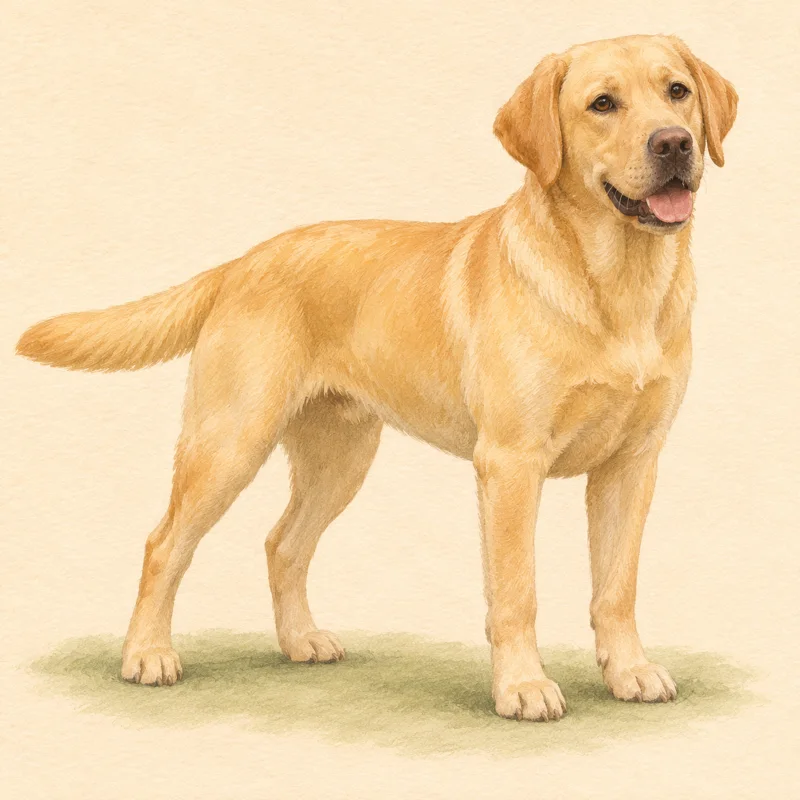
From Newfoundland to the field
The Labrador’s roots lie with dogs used by Newfoundland fishing communities. Dogs brought to England were developed for retrieving work. That working background helps explain why many Labradors enjoy carrying, searching and interacting with people, though interests differ between dogs.
Read the evidence: Labrador Retriever: breed background — Royal Kennel Club
A companion, not a stereotype
The breed standard aims for a responsive, sociable dog. It does not promise an instantly calm family pet. Meet the individual and ask about their experience with people, dogs and daily routines. A Labrador’s enthusiasm still needs patient teaching and appropriate supervision.
Read the evidence: Labrador Retriever: breed standard — Royal Kennel Club
Short hair, two layers
The Labrador has a dense outer coat and weather-resistant undercoat. Short hair does not mean no shedding or no grooming. Check the coat and skin while brushing, choosing a gentle tool suited to its density rather than repeatedly scraping at the skin.
Read the evidence: Labrador Retriever: breed standard — Royal Kennel Club · Dog grooming tips — ASPCA
Give the retrieving brain a job
As practical starting points, teach a comfortable lead walk, recall and a calm exchange of toys. Reward the behaviour you want. PDSA notes that working-line Labradors in particular need outlets for their desire to work and retrieve.
Read the evidence: Reward-based training — Australian Veterinary Association · Labrador health — PDSA
Food for the individual
Choose complete food for the appropriate life stage. Adjust feeding to body condition and activity with veterinary guidance; health concerns or prescribed diets need individual advice.
Read the evidence: Nutrition — Virginia Tech Veterinary Teaching Hospital
More than a quick trip outside
This is an active gundog, and the Kennel Club places adult Labradors in a high exercise category. Walks can include sniffing and learning, rather than constant high-intensity fetching. Puppies, older dogs and dogs with joint concerns need an individually suitable plan, not an adult target copied from a breed chart.
Read the evidence: Labrador Retriever: breed background — Royal Kennel Club
Puppy, adult and mature years
Young dogs: introduce experiences gently; stop when worried. Try calmly giving up a toy for a reward. Discuss safe socialisation with your vet.
All ages: choose safe activities your dog enjoys. An idea to try: carrying a soft toy back over a short, clear route. These are options, not breed requirements or a test of intelligence.
Mature dogs: adapt activities to ability with veterinary advice. For example, offer a nearby toy instead of repeated long retrieves. Keep companionship and enjoyable choices in their day.
Read the evidence: Puppy socialisation — UC Davis Veterinary Medicine · Environmental enrichment — Purdue Canine Welfare Science · Senior dog enrichment — Cornell University
Joints, eyes and weight
PDSA lists hip and elbow dysplasia, progressive retinal atrophy and a tendency towards obesity as concerns. Discuss relevant parental screening with a breeder and your vet. Keep body-condition checks in the routine; reluctance to move or a change in weight deserves attention rather than being put down to breed or age.
Read the evidence: Labrador health — PDSA
Brushing and cleaning
Remove loose hair with gentle brushing and check paws and coat after outdoor activity. Adjust care to what the coat actually needs. Swimming is not a substitute for checking ears: ask your vet about suitable care after water exposure, particularly if your dog has a history of ear trouble.
Read the evidence: Dog grooming tips — ASPCA · How to clean your dog’s ears — Cornell University
Keep care comfortable
Reward-based training is preferable to fear or pain. Pause if handling becomes difficult.
Avoid cotton buds in ears. Pain, redness or persistent odour needs a vet, not more cleaning.
Do not pull at severe mats or cut close to skin. Ask a professional for help. Bathing frequency should suit the individual.
Read the evidence: Reward-based training — Australian Veterinary Association · How to clean your dog’s ears — Cornell University · Coat care: preventing matted hair — USDA APHIS
Sources & scope
Source retrieval dates are recorded individually below. Written as general owner education by Good Dog; not clinically reviewed or endorsed by the organisations linked below. Breed standards describe ideals, not guarantees. Screening advice can change. These are selected considerations, not a complete list of conditions.
- Labrador Retriever: breed background — Royal Kennel Club
Origins and broad breed context; screening signposting.
Source retrieved 2026-11-10 - Labrador Retriever: breed standard — Royal Kennel Club
Coat description and breed temperament ideal, not an individual guarantee.
Source retrieved 2026-11-10 - Dog grooming tips — ASPCA
Gentle brushing by coat type, face cleaning and bathing. Older ear-cleaner advice not adopted; Cornell takes precedence.
Source retrieved 2026-11-10 - Reward-based training — Australian Veterinary Association
Positive reinforcement; avoid fear/pain-based training.
Source retrieved 2026-11-10 - Labrador health — PDSA
Joint and eye concerns, obesity, reward-based training.
Source retrieved 2026-11-10 - Nutrition — Virginia Tech Veterinary Teaching Hospital
Life-stage complete diet, body condition and individual nutritional assessment.
Source retrieved 2026-11-10 - Puppy socialisation — UC Davis Veterinary Medicine
Brief positive experiences and gentle handling; veterinary vaccination context.
Source retrieved 2026-11-10 - Environmental enrichment — Purdue Canine Welfare Science
Individual preferences and safe activity at all ages. Specific suggested games are editorial applications, not breed requirements.
Source retrieved 2026-11-10 - Senior dog enrichment — Cornell University
Adapt activity to ability and discuss safe choices with a vet.
Source retrieved 2026-11-10 - How to clean your dog’s ears — Cornell University
Avoid overcleaning and cotton buds; pain/odour requires veterinary advice.
Source retrieved 2026-11-10 - Coat care: preventing matted hair — USDA APHIS
Friction-area mats, variable grooming frequency and risks from matting or scissors.
Source retrieved 2026-11-10