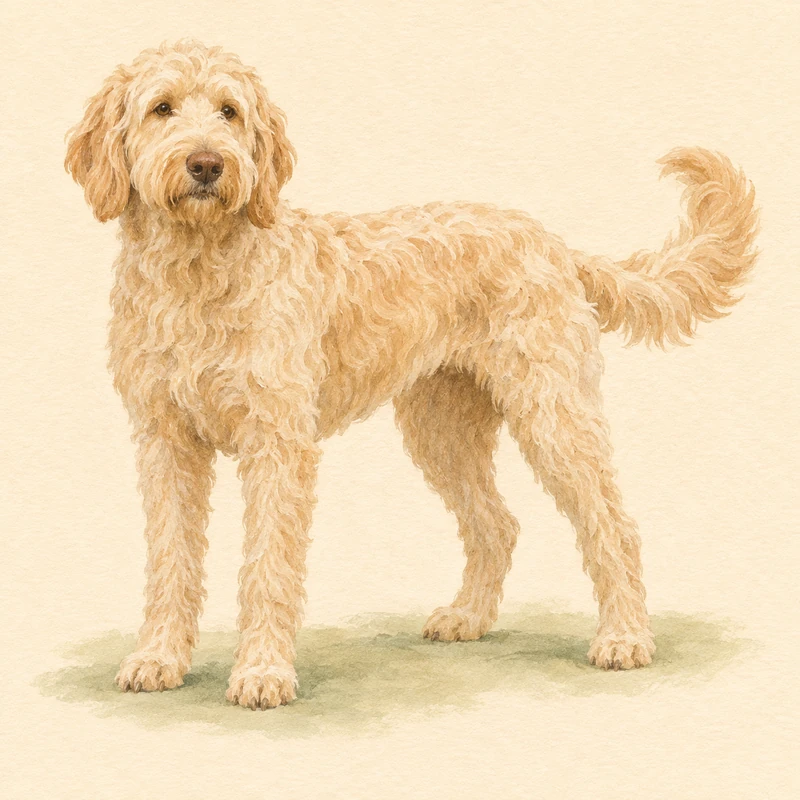
What the name tells you
A Labradoodle combines Labrador Retriever and Poodle ancestry. The association traces its modern development to Australian guide-dog breeding in the 1980s. The Australian Labradoodle has a more complex breeding history that can also include Cocker Spaniel. Ask about actual parentage and generation rather than treating these labels as interchangeable.
Read the evidence: Labradoodle definitions — Australian Labradoodle Association of America · Labradoodle development — Australian Labradoodle Association of America
Meet the individual
When meeting a Labradoodle, ask how they cope with other dogs, children and time alone. These practical questions help you get to know the individual and plan the support they need.
Read the evidence: Questions to ask when adopting a dog — Dogs Trust
A crossbreed has no single coat recipe
Hair texture and shedding can vary with parentage and generation. Do not infer a uniform double coat, maintenance schedule or allergy-safe dog from the Labradoodle label. Ask a groomer to assess density, texture and tangling in this dog.
Read the evidence: Labradoodle definitions — Australian Labradoodle Association of America
Reward useful everyday choices
Reward a loose lead, returning to you and resting calmly. Keep practice manageable and avoid fear-based methods.
Read the evidence: Reward-based training — Australian Veterinary Association
Food and portions
Choose complete life-stage food. Review portions, body condition and treats with your vet.
Read the evidence: Nutrition — Virginia Tech Veterinary Teaching Hospital
Plan for an active companion
The Labrador and Standard Poodle have working retrieving backgrounds. That makes an active routine a sensible starting expectation, not a guaranteed requirement for every cross. Build walks and play around the individual’s size, health and fitness.
Read the evidence: Labrador Retriever — Royal Kennel Club · Standard Poodle — Royal Kennel Club
As your dog grows older
Growing puppies need growth-appropriate food; older dogs need individual dietary review, especially with illness.
Read the evidence: Nutrition — Virginia Tech Veterinary Teaching Hospital
Crossbreeding is not health insurance
A 2024 UK owner-survey study of dogs aged up to five found no statistically significant difference in most of the common-disorder comparisons between Labradoodles and their parent breeds. It does not establish identical lifetime health or a blanket crossbreed advantage. Discuss parent-appropriate hip, eye and other screening with your vet; the relevant Poodle variety matters.
Read the evidence: The doodle dilemma — Bryson et al., PLOS ONE (2024) · Labrador Retriever — Royal Kennel Club · Standard Poodle — Royal Kennel Club
Look beneath the surface
Check behind ears, under collars and in armpits. Tangling can hide below a tidy surface; ask for a comfortable brush-and-comb demonstration.
Read the evidence: Coat Care: Preventing Matted Hair — USDA APHIS
Bathing is separate from brushing
Use lukewarm water and suitable dog shampoo, then rinse thoroughly. Keep water and shampoo away from eyes and ears.
Read the evidence: Dog grooming tips — ASPCA
Comfort comes first
Avoid cotton buds. Pain, redness or unusual ear odour needs veterinary advice rather than more cleaning.
Read the evidence: How to clean your dog’s ears — Cornell University
Sources & scope
Source retrieval dates are recorded individually below. Written as general owner education by Good Dog; not clinically reviewed or endorsed by the organisations linked below. Breed standards describe ideals, not guarantees. Screening advice can change. These are selected considerations, not a complete list of conditions.
- Labradoodle definitions — Australian Labradoodle Association of America
Labrador/Poodle parentage, distinction from Australian Labradoodles, coat variation. Promotional health/allergy/temperament promises not adopted.
Source retrieved 2026-11-11 - Labradoodle development — Australian Labradoodle Association of America
Australian guide-dog breeding background in the 1980s only; allergy-friendly breeding aims are not an allergy guarantee.
Source retrieved 2026-11-11 - Questions to ask when adopting a dog — Dogs Trust
General owner questions about individual behaviour, other dogs, children and time alone. Editorial application to Labradoodles, not breed-specific temperament research.
Source retrieved 2026-11-11 - Reward-based training — Australian Veterinary Association
Positive reinforcement and avoidance of aversive methods. Examples are editorial applications, not breed trials.
Source retrieved 2026-11-11 - Nutrition — Virginia Tech Veterinary Teaching Hospital
Complete life-stage food, individual portions and older-dog assessment. No US label wording prescribed for UK products.
Source retrieved 2026-11-11 - Labrador Retriever — Royal Kennel Club
Parent-breed history/activity/screening only; no crossbreed prevalence inferred.
Source retrieved 2026-11-11 - Standard Poodle — Royal Kennel Club
Parent-breed history/activity/screening only; no crossbreed prevalence inferred.
Source retrieved 2026-11-11 - The doodle dilemma — Bryson et al., PLOS ONE (2024)
Owner-reported cross-sectional UK study of dogs up to five years. Does not establish lifetime outcomes or Sprocker outcomes.
Source retrieved 2026-11-11 - Coat Care: Preventing Matted Hair — USDA APHIS
Friction-area matting, gentle prevention and professional help. No home scissor removal.
Source retrieved 2026-11-11 - Dog grooming tips — ASPCA
Lukewarm water, pet shampoo, rinsing and avoiding eyes/ears. Fixed bathing intervals and cotton-in-ear advice not adopted.
Source retrieved 2026-11-11 - How to clean your dog’s ears — Cornell University
No cotton buds; painful or inflamed ears require assessment rather than repeated cleaning.
Source retrieved 2026-11-11