Editorial context: practical handling ideas and questions are examples, not tested breed-specific outcomes or guarantees. Read the source scope and limitations below.
Training games and household examples are editorial applications. Health-screening items are selected current pre-breeding signposts, not a complete list of illnesses or an individual health assessment.
The Greyhound in its own right
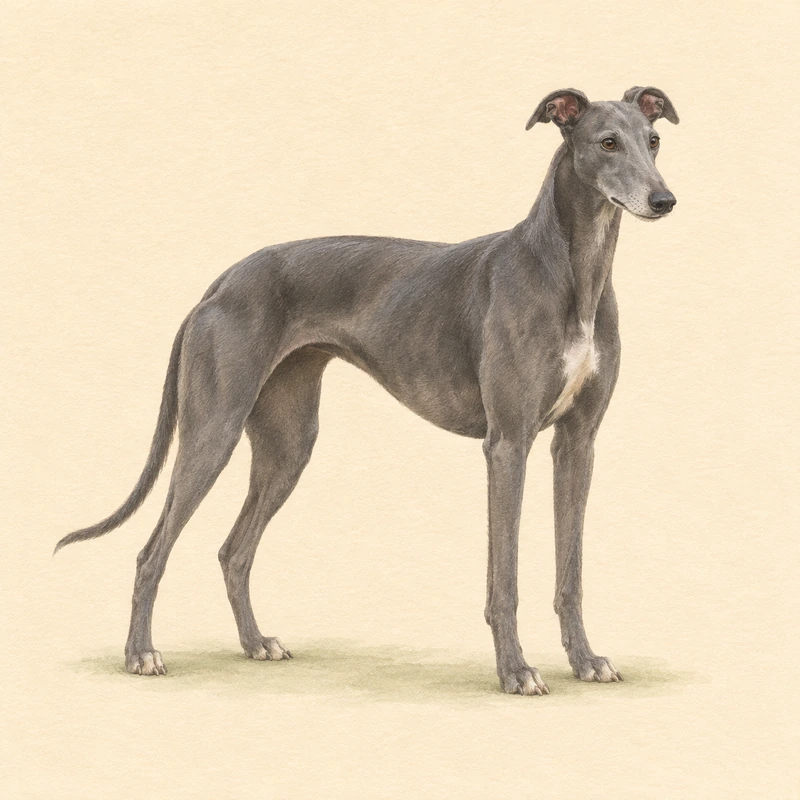
The Royal Kennel Club describes the Greyhound’s development in Britain and distinguishes show and racing types. This guide concerns the Greyhound, not the Italian Greyhound or Whippet. An individual may have a racing background, but that history should be established from records rather than assumed from appearance.
Editorial example based on the cited general guidance, not a breed-specific trial finding or individual prediction.
Read the evidence: Greyhound background and screening — Royal Kennel Club
Learn the dog behind the gentle ideal
Gentleness and affection appear in the standard. A newly arrived dog still needs time for you to learn its preferences. Ask which greetings, household sounds and handling situations are familiar, and avoid interpreting quietness as consent to every interaction.
Editorial example based on the cited general guidance, not a breed-specific trial finding or individual prediction.
Read the evidence: Greyhound standard — Royal Kennel Club · Reward-based dog training — Australian Veterinary Association
A fine covering, not a full assessment
The standard describes a fine, close coat. There is relatively little hair to manage compared with long-coated breeds, but appearance alone cannot tell you how the dog feels. Include skin comfort in ordinary care rather than treating a sleek outline as proof of health.
Editorial example based on the cited general guidance, not a breed-specific trial finding or individual prediction.
Read the evidence: Greyhound standard — Royal Kennel Club · Adopting a Greyhound — Battersea
Reward a useful household pause
Practise rewarding the dog for pausing comfortably on a mat while you sit nearby. Let the dog move away if it needs space. A calm household skill can be a more useful starting point than demanding a display of athletic ability.
Editorial example based on the cited general guidance, not a breed-specific trial finding or individual prediction.
Read the evidence: Reward-based dog training — Australian Veterinary Association
Assess condition rather than the silhouette alone
Food amounts depend on the dog’s size, activity and condition. Ask your vet to help assess an appropriate body condition instead of deciding from a generic picture of a slim sighthound.
Editorial example based on the cited general guidance, not a breed-specific trial finding or individual prediction.
Read the evidence: Greyhound care — Dogs Trust
Speed is not a daily assignment
Build an outing plan around age, health and confidence. Walks, opportunities to investigate and gentle interaction can be adjusted individually; neither forced running nor a blanket short-walk limit follows from the breed name. Discuss injury or illness with your vet before increasing activity.
Editorial example based on the cited general guidance, not a breed-specific trial finding or individual prediction.
Read the evidence: Greyhound care — Dogs Trust
A new home can be a new chapter
For an adult arrival, collect the previous routine and medical history, then review feeding and activity as home life changes. For an older dog, altered appetite or weight warrants a veterinary conversation rather than an assumption that retirement explains everything.
Editorial example based on the cited general guidance, not a breed-specific trial finding or individual prediction.
Read the evidence: Nutrition — Virginia Tech Veterinary Teaching Hospital · Greyhound care — Dogs Trust
Keep screening separate from the full history
The Royal Kennel Club currently lists a DNA test for Greyhound neuropathy under best practice. That does not replace review of the individual’s previous injuries, illnesses and ongoing care with a vet. Ask what the available test records establish and where information is missing.
Editorial example based on the cited general guidance, not a breed-specific trial finding or individual prediction.
Read the evidence: Greyhound background and screening — Royal Kennel Club · Greyhound care — Dogs Trust
Make touch predictable
Introduce brushing in small, positive steps. A short coat generally needs modest brushing, but the dog’s willingness to participate should determine how much happens in one session.
Inherit the specific scope and limitations of cited sources.
Read the evidence: Greyhound care — Dogs Trust
Wash for need, not a cosmetic schedule
Battersea describes relatively low bathing needs for this short coat. When washing is necessary, keep water away from eyes and ears and dry carefully.
Inherit the specific scope and limitations of cited sources.
Read the evidence: Adopting a Greyhound — Battersea · Dog Grooming Tips — ASPCA
Plan space and control individually
Make room for the dog to stretch out and turn comfortably in its resting area. Ask the rescue or a qualified professional about suitable walking equipment and safe introductions. Off-lead access and chase games are not automatic recommendations: decide on containment, surroundings and the particular dog’s behaviour first.
Editorial example based on the cited general guidance, not a breed-specific trial finding or individual prediction.
Read the evidence: Greyhound care — Dogs Trust
Sources & scope
Source retrieval dates are recorded individually below. Written as general owner education by Good Dog; not clinically reviewed or endorsed by the organisations linked below. Breed standards describe ideals, not guarantees. Screening advice can change. These are selected considerations, not a complete list of conditions.
- Greyhound background and screening — Royal Kennel Club
Attributed history and current pre-breeding screening signposts.
Limitations: Secondary historical narrative; screening listings are time-sensitive and not an individual health guarantee. Fixed activity quotas and lifespan claims excluded.
Source retrieved 2026-11-11 - Greyhound standard — Royal Kennel Club
Temperament ideals and coat description.
Limitations: Conformation standard, not behaviour research or a clinical assessment. No working capacity or individual temperament guarantee adopted.
Publication or revision: 1 August 2025
Source retrieved 2026-11-11 - Reward-based dog training — Australian Veterinary Association
Positive reinforcement rather than pain or fear.
Limitations: General veterinary policy; the particular practice games in these guides are editorial examples, not tested breed-specific interventions.
Publication or revision: 5 November 2021 ratification
Source retrieved 2026-11-11 - Adopting a Greyhound — Battersea
Rest, interaction and modest coat maintenance in home life.
Limitations: Adoption-focused generalisations are not individual predictions. Couch-potato, perfect-pet and universal short-walk claims excluded.
Publication or revision: Published 6 December 2023; updated 30 June 2026
Source retrieved 2026-11-11 - Greyhound care — Dogs Trust
Individual activity, food, positive handling and home-space planning.
Limitations: Rescue owner education, not a population trial. No blanket off-lead permission or promise of compatibility.
Source retrieved 2026-11-11 - Nutrition — Virginia Tech Veterinary Teaching Hospital
Individual portions, life-stage review and appetite/weight changes.
Limitations: No suggested waiting period for appetite loss, recipes, supplement doses or US labelling requirements adopted.
Source retrieved 2026-11-11 - Dog Grooming Tips — ASPCA
Gentle brushing, bathing, eye/ear water avoidance and drying.
Limitations: Charity page includes affiliate links. Fixed bath frequency, ear packing, eye lubricant and home cutting instructions excluded.
Source retrieved 2026-11-11