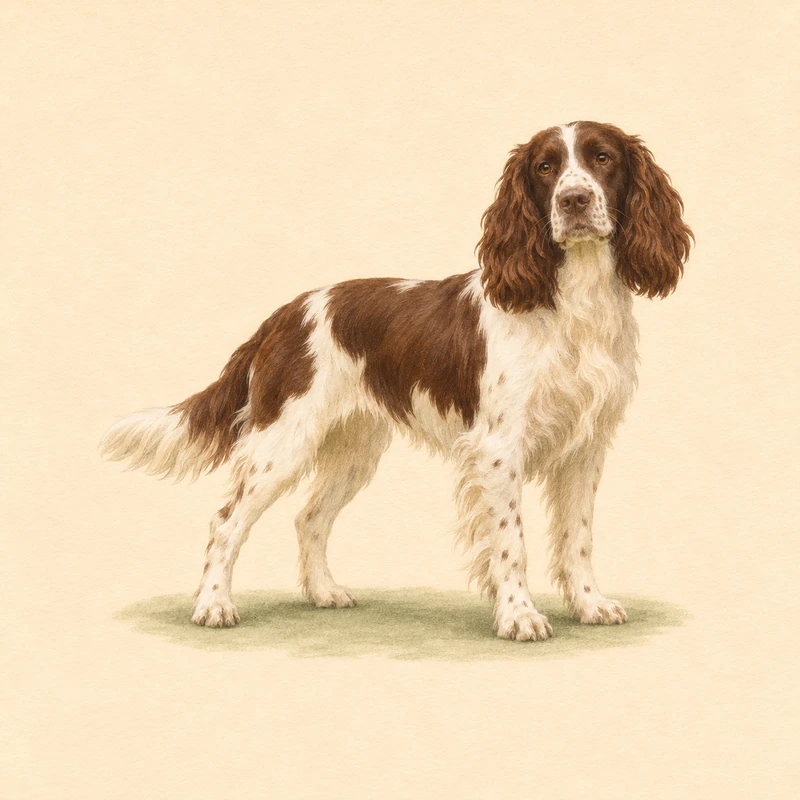
The dog that springs game
English Springers share ancestry with other land spaniels. Their name reflects flushing game from cover, first towards nets and later for shooting. Their working history helps explain why searching outdoors can be so engaging.
Read the evidence: Sporting breed standards — Canadian Kennel Club
Friendly is a breed ideal
The standard describes a happy, responsive companion. That is a general ideal, not a promise that every Springer welcomes every dog or child. Learn your own dog’s signals and allow space when they need it.
Read the evidence: English Springer Spaniel breed standard — Royal Kennel Club
Two layers and longer feathering
The Springer has a double coat, with an undercoat beneath the outer hair. The outer coat is close and weather resistant, with longer feathering around ears, legs and body. These longer areas need checking rather than brushing only the back.
Read the evidence: Sporting breed standards — Canadian Kennel Club · English Springer Spaniel breed standard — Royal Kennel Club
Practise useful field-to-home skills
Reward returning, giving up a toy and settling. Use short, achievable sessions; enthusiasm is not a reason to use punishment.
Read the evidence: Reward-based training — Australian Veterinary Association
Food and portions
Choose complete life-stage food. Review portions, body condition and treats with your vet.
Read the evidence: Nutrition — Virginia Tech Veterinary Teaching Hospital
An active breed, an individual plan
Springers sit in a high exercise category in breed guidance. Mix appropriate walks with opportunities to sniff and learn, rather than copying adult targets for puppies. Age, injury and fitness can change what is comfortable.
Read the evidence: English Springer Spaniel breed background — Royal Kennel Club
As your dog grows older
Growing puppies need growth-appropriate food; older dogs need individual dietary review, especially with illness.
Read the evidence: Nutrition — Virginia Tech Veterinary Teaching Hospital
Joints, eyes and ears
Hip and elbow dysplasia, progressive retinal atrophy and ear infections are among PDSA’s cautions. Discuss current screening with your vet and breeder. Limping, vision changes or painful ears deserve attention, not an assumption that they are normal for spaniels.
Read the evidence: English Springer Spaniel — PDSA
Check feathering calmly
Work gently around ears, collars and armpits. Ask a professional to tackle tight mats rather than pulling or cutting them out.
Read the evidence: Coat Care: Preventing Matted Hair — USDA APHIS
Bathing is separate from brushing
Use lukewarm water and suitable dog shampoo, then rinse thoroughly. Keep water and shampoo away from eyes and ears.
Read the evidence: Dog grooming tips — ASPCA
Comfort comes first
Avoid cotton buds. Pain, redness or unusual ear odour needs veterinary advice rather than more cleaning.
Read the evidence: How to clean your dog’s ears — Cornell University
Sources & scope
Source retrieval dates are recorded individually below. Written as general owner education by Good Dog; not clinically reviewed or endorsed by the organisations linked below. Breed standards describe ideals, not guarantees. Screening advice can change. These are selected considerations, not a complete list of conditions.
- Sporting breed standards — Canadian Kennel Club
English Springer double coat description; not evidence of identical coats in Sprockers.
Source retrieved 2026-11-11 - English Springer Spaniel breed standard — Royal Kennel Club
Coat and temperament ideals, not individual guarantees.
Source retrieved 2026-11-11 - Reward-based training — Australian Veterinary Association
Positive reinforcement and avoidance of aversive methods. Examples are editorial applications, not breed trials.
Source retrieved 2026-11-11 - Nutrition — Virginia Tech Veterinary Teaching Hospital
Complete life-stage food, individual portions and older-dog assessment. No US label wording prescribed for UK products.
Source retrieved 2026-11-11 - English Springer Spaniel breed background — Royal Kennel Club
History, activity and current health screening; not a prescription.
Source retrieved 2026-11-11 - English Springer Spaniel — PDSA
Selected health cautions and everyday care; fixed schedules, prices and promotional material not adopted.
Source retrieved 2026-11-11 - Coat Care: Preventing Matted Hair — USDA APHIS
Friction-area matting, gentle prevention and professional help. No home scissor removal.
Source retrieved 2026-11-11 - Dog grooming tips — ASPCA
Lukewarm water, pet shampoo, rinsing and avoiding eyes/ears. Fixed bathing intervals and cotton-in-ear advice not adopted.
Source retrieved 2026-11-11 - How to clean your dog’s ears — Cornell University
No cotton buds; painful or inflamed ears require assessment rather than repeated cleaning.
Source retrieved 2026-11-11