Editorial context: practical handling ideas and questions are examples, not tested breed-specific outcomes or guarantees. Read the source scope and limitations below.
Training games and household examples are editorial applications. Health-screening items are selected current pre-breeding signposts, not a complete list of illnesses or an individual health assessment.
A carriage history with uncertain earlier origins
The Royal Kennel Club acknowledges uncertainty about the breed’s origins and name. Its account describes spotted dogs accompanying horse-drawn carriages and later associations with fire engines. The familiar name alone is not firm evidence for a precise birthplace.
Inherit the specific scope and limitations of cited sources.
Read the evidence: Dalmatian background and screening — Royal Kennel Club
Friendly is a standard, not a promise
The standard seeks an outgoing, friendly dog. Ask how the individual responds to people, dogs and handling. If a dog appears not to respond to a sound, do not immediately call it stubborn; hearing is one topic to discuss with your vet.
Editorial example based on the cited general guidance, not a breed-specific trial finding or individual prediction.
Read the evidence: Dalmatian standard — Royal Kennel Club · Dalmatian background and screening — Royal Kennel Club
Short hair and distinctive spotting
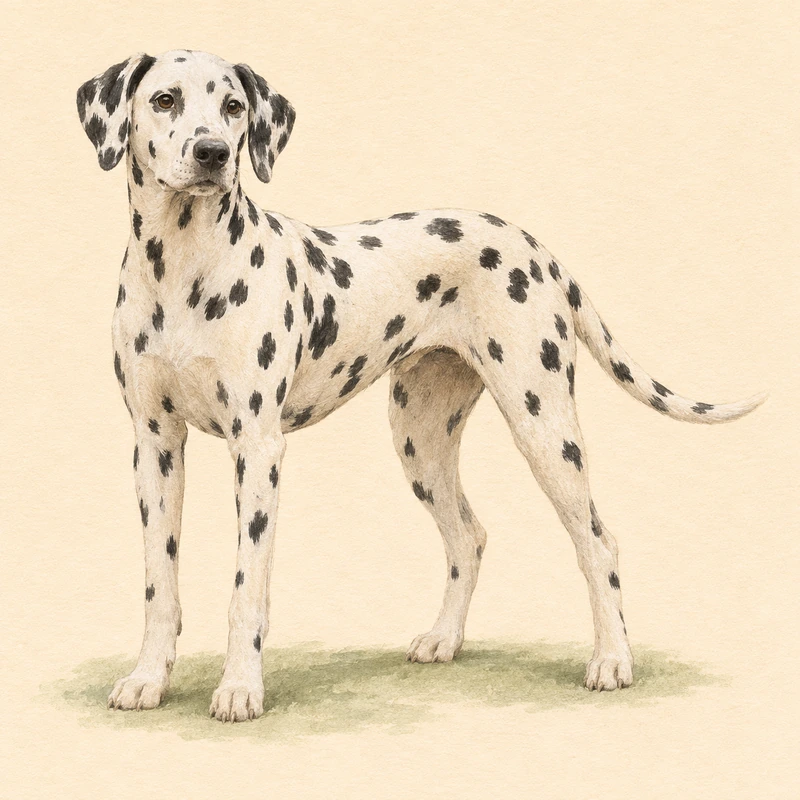
The standard describes a short, hard, dense coat, with black or liver spotting on white. A pattern admired in the show ring is not a health certificate. Put the dog’s comfort and medical history ahead of a particular arrangement of spots.
Editorial example based on the cited general guidance, not a breed-specific trial finding or individual prediction.
Read the evidence: Dalmatian standard — Royal Kennel Club
Keep a signal easy to understand
Try pairing a simple hand signal with a rewarded behaviour the dog already finds easy. This is an editorial practice idea, not a replacement for hearing assessment or individual support. Use rewards rather than escalating pressure when communication is unclear.
Editorial example based on the cited general guidance, not a breed-specific trial finding or individual prediction.
Read the evidence: Reward-based dog training — Australian Veterinary Association · Dalmatian background and screening — Royal Kennel Club
Urinary concerns need an individual plan
Ask your vet about feeding in light of the dog’s life stage, history and any urinary findings. Do not start a preventive restriction or medication from a breed guide. A urinary-risk label alone does not supply a safe diet prescription.
Editorial example based on the cited general guidance, not a breed-specific trial finding or individual prediction.
Read the evidence: Evaluating Pet Food — NC State Veterinary Hospital · Hyperuricosuria and urolithiasis — Cornell University College of Veterinary Medicine
Separate heritage from conditioning
Accompanying carriages is historical context, not a ready-made fitness plan. An enjoyable walk with pauses to investigate is an editorial starting idea. Build the routine around current health and conditioning rather than asking a young or unfit dog to demonstrate endurance.
Editorial example based on the cited general guidance, not a breed-specific trial finding or individual prediction.
Read the evidence: Dalmatian background and screening — Royal Kennel Club
Carry useful records forward
Keep feeding and health records as a puppy grows or an adult changes homes. Changes in weight, appetite or health call for a review with your vet, not an automatic continuation of the old ration.
Editorial example based on the cited general guidance, not a breed-specific trial finding or individual prediction.
Read the evidence: Nutrition — Virginia Tech Veterinary Teaching Hospital
Two distinct conversations: hearing and urate risk
Current registry guidance includes BAER hearing testing, including litter screening, and a DNA test for hyperuricosuria (HUU). Cornell explains the Dalmatian association with urate stones but stresses that not all Dalmatians develop stones. Ask your vet to interpret the dog’s own results and history; hearing testing and urinary assessment answer different questions.
Editorial example based on the cited general guidance, not a breed-specific trial finding or individual prediction.
Read the evidence: Dalmatian background and screening — Royal Kennel Club · Hyperuricosuria and urolithiasis — Cornell University College of Veterinary Medicine
Gentle attention to the short coat
Brush gently to remove loose hair and dirt. Use the opportunity to notice discomfort, rather than scrubbing a short coat harder to make it shine.
Editorial example based on the cited general guidance, not a breed-specific trial finding or individual prediction.
Read the evidence: Dog Grooming Tips — ASPCA
Keep cleaning comfortable
Use a suitable dog shampoo when washing is needed. Rinse it out and dry the coat, protecting the face from the water stream.
Inherit the specific scope and limitations of cited sources.
Read the evidence: Dog Grooming Tips — ASPCA
Difficulty passing urine cannot wait
Straining, frequent small amounts of urine or blood in urine need prompt veterinary advice. Inability to pass urine is an emergency: seek immediate emergency veterinary care. These signs do not establish that a stone is present, and changing food at home is not an adequate response to possible obstruction.
Inherit the specific scope and limitations of cited sources.
Read the evidence: Hyperuricosuria and urolithiasis — Cornell University College of Veterinary Medicine
Sources & scope
Source retrieval dates are recorded individually below. Written as general owner education by Good Dog; not clinically reviewed or endorsed by the organisations linked below. Breed standards describe ideals, not guarantees. Screening advice can change. These are selected considerations, not a complete list of conditions.
- Dalmatian background and screening — Royal Kennel Club
Attributed history and current pre-breeding screening signposts.
Limitations: Secondary historical narrative; screening listings are time-sensitive and not an individual health guarantee. Fixed activity quotas and lifespan claims excluded.
Source retrieved 2026-11-11 - Dalmatian standard — Royal Kennel Club
Temperament ideals and coat description.
Limitations: Conformation standard, not behaviour research or a clinical assessment. No working capacity or individual temperament guarantee adopted.
Publication or revision: January 2025
Source retrieved 2026-11-11 - Reward-based dog training — Australian Veterinary Association
Positive reinforcement rather than pain or fear.
Limitations: General veterinary policy; the particular practice games in these guides are editorial examples, not tested breed-specific interventions.
Publication or revision: 5 November 2021 ratification
Source retrieved 2026-11-11 - Evaluating Pet Food — NC State Veterinary Hospital
Complete life-stage food and individual veterinary advice.
Limitations: US label examples are not UK regulation. Brands, recipes and transition percentages excluded.
Source retrieved 2026-11-11 - Hyperuricosuria and urolithiasis — Cornell University College of Veterinary Medicine
Dalmatian urate risk, variable stone development, urinary signs and emergency obstruction.
Limitations: Clinical owner education, not a current population prevalence study. Numerical mutation/recurrence risks, molecular shorthand, prophylactic diets and medication advice excluded; no claim all Dalmatians develop stones.
Source retrieved 2026-11-11 - Nutrition — Virginia Tech Veterinary Teaching Hospital
Individual portions, life-stage review and appetite/weight changes.
Limitations: No suggested waiting period for appetite loss, recipes, supplement doses or US labelling requirements adopted.
Source retrieved 2026-11-11 - Dog Grooming Tips — ASPCA
Gentle brushing, bathing, eye/ear water avoidance and drying.
Limitations: Charity page includes affiliate links. Fixed bath frequency, ear packing, eye lubricant and home cutting instructions excluded.
Source retrieved 2026-11-11