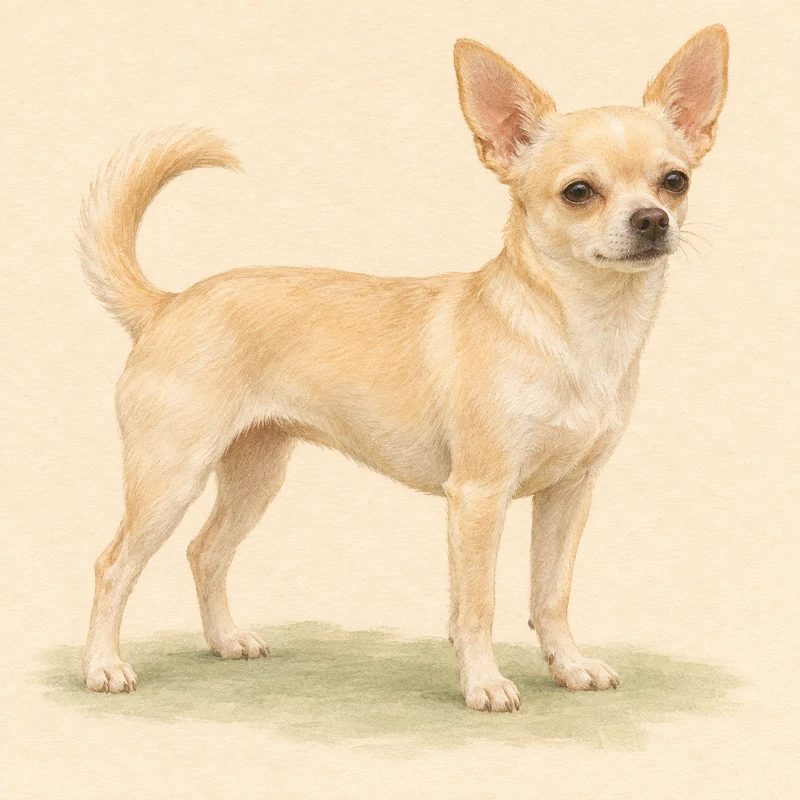
A Mexican companion with uncertain ancient roots
The modern Chihuahua became widely known through dogs brought from Mexico in the nineteenth century. Earlier ancestry is less certain than neat origin stories suggest. This guide avoids treating disputed links to ancient dogs as settled fact.
Read the evidence: Chihuahua standard — United Kennel Club
A dog, not an accessory
Chihuahuas can be alert, active companions. Small size does not remove their need for choice: avoid repeatedly picking up a dog that wants space. Individual behaviour and experience matter, and interactions with children need supervision.
Read the evidence: Chihuahua standard — United Kennel Club · Chihuahua — PDSA
Short or long is only part of the picture
Chihuahuas may be single or double coated. When present, the undercoat is soft and close to the body. Long-coated dogs have extra feathering, so do not assume that all Chihuahuas need the same brush or grooming routine.
Read the evidence: Chihuahua standard — United Kennel Club
Small steps, worthwhile rewards
Reward coming when called and comfortable handling. Keep practice achievable and gentle; tiny dogs still need opportunities to learn.
Read the evidence: Reward-based training — Australian Veterinary Association
Food and portions
Choose complete life-stage food. Review portions, body condition and treats with your vet.
Read the evidence: Nutrition — Virginia Tech Veterinary Teaching Hospital
Let little legs explore
Small dogs still benefit from walks, sniffing and play. Keep the pace suitable for your Chihuahua rather than carrying them everywhere or matching a larger dog’s stride. Adapt the routine to health, age and comfort.
Read the evidence: Chihuahua — PDSA
As your dog grows older
Growing puppies need growth-appropriate food; older dogs need individual dietary review, especially with illness.
Read the evidence: Nutrition — Virginia Tech Veterinary Teaching Hospital
Knees and eyes deserve attention
PDSA highlights slipping kneecaps and several eye problems among possible concerns. Ask your vet about family history and appropriate checks. Limping or a painful eye warrants assessment; these risks do not mean that every Chihuahua will be affected.
Read the evidence: Chihuahua — PDSA
Work with coat length
PDSA suggests more frequent brushing for long coats than smooth coats. Check loose hair and tangles gently, with extra care around feathering.
Read the evidence: Chihuahua — PDSA
Bathing is separate from brushing
Use lukewarm water and suitable dog shampoo, then rinse thoroughly. Keep water and shampoo away from eyes and ears.
Read the evidence: Dog grooming tips — ASPCA
Comfort comes first
Avoid cotton buds. Pain, redness or unusual ear odour needs veterinary advice rather than more cleaning.
Read the evidence: How to clean your dog’s ears — Cornell University
Sources & scope
Source retrieval dates are recorded individually below. Written as general owner education by Good Dog; not clinically reviewed or endorsed by the organisations linked below. Breed standards describe ideals, not guarantees. Screening advice can change. These are selected considerations, not a complete list of conditions.
- Chihuahua standard — United Kennel Club
Uncertain ancient history, variable single/double coat and general temperament only.
Source retrieved 2026-11-11 - Chihuahua — PDSA
Selected health cautions and everyday care; fixed schedules, prices and promotional material not adopted.
Source retrieved 2026-11-11 - Reward-based training — Australian Veterinary Association
Positive reinforcement and avoidance of aversive methods. Examples are editorial applications, not breed trials.
Source retrieved 2026-11-11 - Nutrition — Virginia Tech Veterinary Teaching Hospital
Complete life-stage food, individual portions and older-dog assessment. No US label wording prescribed for UK products.
Source retrieved 2026-11-11 - Dog grooming tips — ASPCA
Lukewarm water, pet shampoo, rinsing and avoiding eyes/ears. Fixed bathing intervals and cotton-in-ear advice not adopted.
Source retrieved 2026-11-11 - How to clean your dog’s ears — Cornell University
No cotton buds; painful or inflamed ears require assessment rather than repeated cleaning.
Source retrieved 2026-11-11