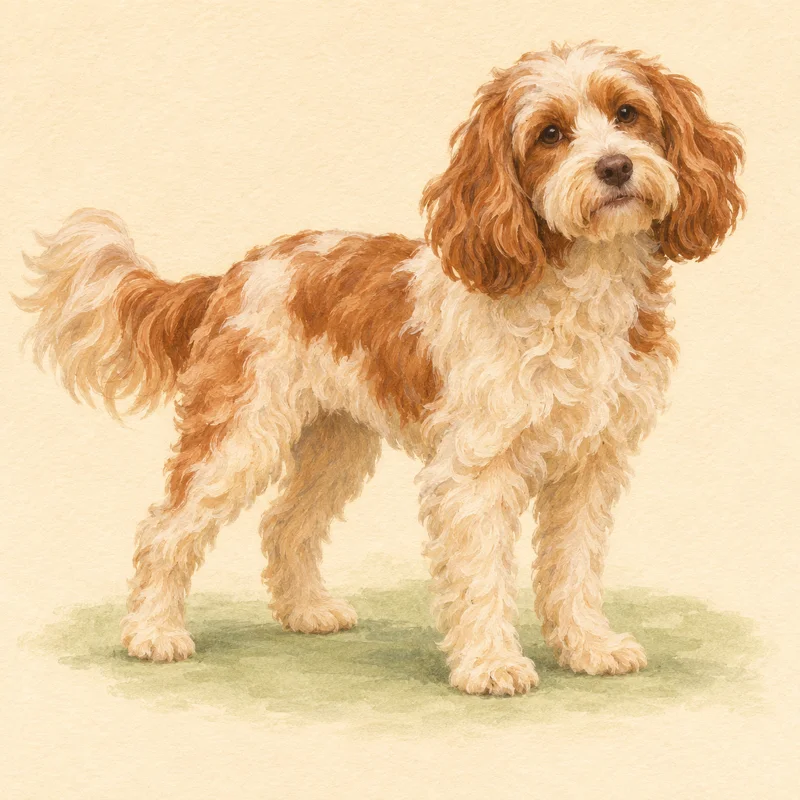
Start with the two parent breeds
Cavapoo describes a Cavalier King Charles Spaniel–Poodle cross. The Cavalier side comes from a long toy-spaniel history. This guide does not assign a precise “first Cavapoo” date: parentage is better supported than a single origin story, and later-generation crosses can add variation.
Read the evidence: The doodle dilemma — Bryson et al., PLOS ONE (2024) · Cavalier King Charles Spaniel — Royal Kennel Club
A companion with individual needs
Companion ancestry is useful context, but it cannot promise a relaxed or easy-to-train dog. Ask how the individual responds to handling, unfamiliar people and being apart from familiar company. Look for opportunities to build confidence rather than deciding what they ought to enjoy.
Read the evidence: Cavalier King Charles Spaniel — Royal Kennel Club
Let the actual coat guide you
Cavapoo coats vary, and low shedding does not remove the need to brush out retained hair. Do not infer a fixed double-coat type or allergy safety from the crossbreed name. A groomer can help assess texture, tangling and a practical length as the coat develops.
Read the evidence: Cavapoo coat care — Purina
Keep learning clear and kind
Use rewards for small successes, with manageable practice rather than long, demanding sessions. Handling, settling and coming when called are useful foundations. If a dog is distressed, reduce the challenge and seek suitable professional help.
Read the evidence: Reward-based training — Australian Veterinary Association
Food for the individual
Choose complete food for the appropriate life stage. Adjust feeding to body condition and activity with veterinary guidance; health concerns or prescribed diets need individual advice.
Read the evidence: Nutrition — Virginia Tech Veterinary Teaching Hospital
Build a routine, not a quota
Make space for walks, exploring, play and quiet time. Parentage alone cannot set a daily target, particularly for puppies, older dogs or dogs with health concerns. Discuss activity with your vet if your dog tires unexpectedly or seems uncomfortable.
Read the evidence: Cavalier King Charles Spaniel — Royal Kennel Club
Puppy, adult and mature years
Young dogs: introduce experiences gently; stop when worried. Try a brief paw touch followed by a reward. Discuss safe socialisation with your vet.
All ages: choose safe activities your dog enjoys. An idea to try: a simple nose-target game. These are options, not breed requirements or a test of intelligence.
Mature dogs: adapt activities to ability with veterinary advice. For example, bring your target hand to a comfortable height. Keep companionship and enjoyable choices in their day.
Read the evidence: Puppy socialisation — UC Davis Veterinary Medicine · Environmental enrichment — Purdue Canine Welfare Science · Senior dog enrichment — Cornell University
Ask about both sides of the family
Cavalier parent screening includes heart assessment for mitral valve disease and relevant inherited-condition tests. Ask your vet what is appropriate for the Poodle parent too. These parent-breed concerns do not diagnose a Cavapoo. The RVC-led crossbreed study challenges the idea that crossing alone guarantees better overall health.
Read the evidence: Cavalier King Charles Spaniel — Royal Kennel Club · The doodle dilemma — Bryson et al., PLOS ONE (2024)
Brushing and cleaning
Introduce grooming calmly and ask for a demonstration suitable for your dog’s coat. Check around the ears, feet and other areas where hair catches or rubs. A short trim may still need maintenance; the aim is comfortable, tangle-free hair rather than a fixed style.
Read the evidence: Cavapoo coat care — Purina · Coat care: preventing matted hair — USDA APHIS
Keep care comfortable
Reward-based training is preferable to fear or pain. Pause if handling becomes difficult.
Avoid cotton buds in ears. Pain, redness or persistent odour needs a vet, not more cleaning.
Do not pull at severe mats or cut close to skin. Ask a professional for help. Bathing frequency should suit the individual.
Read the evidence: Reward-based training — Australian Veterinary Association · How to clean your dog’s ears — Cornell University · Coat care: preventing matted hair — USDA APHIS
Sources & scope
Source retrieval dates are recorded individually below. Written as general owner education by Good Dog; not clinically reviewed or endorsed by the organisations linked below. Breed standards describe ideals, not guarantees. Screening advice can change. These are selected considerations, not a complete list of conditions.
- The doodle dilemma — Bryson et al., PLOS ONE (2024)
RVC-led owner-reported cross-sectional study; parentage, common-disorder comparisons and study limitations.
Source retrieved 2026-11-10 - Cavalier King Charles Spaniel — Royal Kennel Club
Cavalier parent history and relevant parent screening, not Cavapoo prevalence.
Source retrieved 2026-11-10 - Cavapoo coat care — Purina
Supplementary commercial source for coat variation and grooming only, not diet endorsement.
Source retrieved 2026-11-10 - Reward-based training — Australian Veterinary Association
Positive reinforcement; avoid fear/pain-based training.
Source retrieved 2026-11-10 - Nutrition — Virginia Tech Veterinary Teaching Hospital
Life-stage complete diet, body condition and individual nutritional assessment.
Source retrieved 2026-11-10 - Puppy socialisation — UC Davis Veterinary Medicine
Brief positive experiences and gentle handling; veterinary vaccination context.
Source retrieved 2026-11-10 - Environmental enrichment — Purdue Canine Welfare Science
Individual preferences and safe activity at all ages. Specific suggested games are editorial applications, not breed requirements.
Source retrieved 2026-11-10 - Senior dog enrichment — Cornell University
Adapt activity to ability and discuss safe choices with a vet.
Source retrieved 2026-11-10 - Coat care: preventing matted hair — USDA APHIS
Friction-area mats, variable grooming frequency and risks from matting or scissors.
Source retrieved 2026-11-10 - How to clean your dog’s ears — Cornell University
Avoid overcleaning and cotton buds; pain/odour requires veterinary advice.
Source retrieved 2026-11-10