Editorial context: practical handling ideas and questions are examples, not tested breed-specific outcomes or guarantees. Read the source scope and limitations below.
A distinct toy spaniel
The Royal Kennel Club traces the Cavalier to the older, longer-muzzled toy spaniel type. It recognised the Cavalier as a separate breed in 1945. The Cavalier King Charles Spaniel and the King Charles Spaniel are distinct breeds, despite their similar names.
Read the evidence: Cavalier King Charles Spaniel background and screening — Royal Kennel Club
Affection without assumptions
The standard seeks a friendly, affectionate companion. That ideal does not tell you whether a particular Cavalier welcomes handling, children or unfamiliar dogs. Ask how the dog behaves when tired, worried or approached while resting.
Editorial application, not a breed-specific trial or guaranteed behavioural outcome.
Read the evidence: Cavalier King Charles Spaniel breed standard — Royal Kennel Club
Look beyond the ear feathering
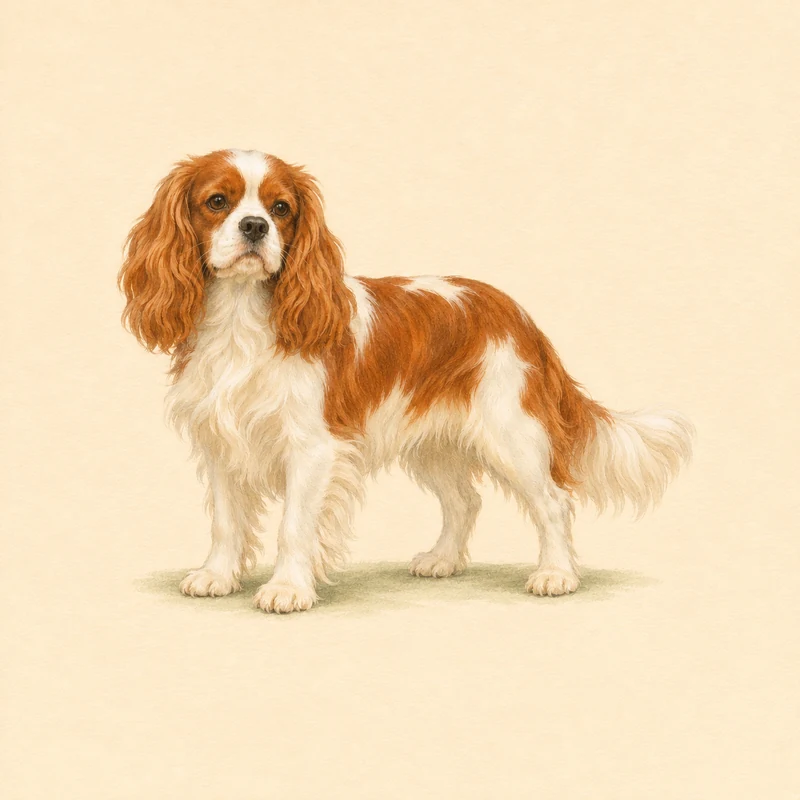
The standard describes a long, silky coat with feathering, allowing a slight wave. Plan care around your dog’s actual coat and comfort rather than treating a show presentation as a household requirement.
Editorial application, not a breed-specific trial or guaranteed behavioural outcome.
Read the evidence: Cavalier King Charles Spaniel breed standard — Royal Kennel Club
Make handling an invitation
Use reward-based practice: reward a comfortable pause beside the brush, then release the dog. Stop if handling seems painful rather than treating reluctance as disobedience.
Editorial application, not a breed-specific trial or guaranteed behavioural outcome.
Read the evidence: Reward-based training — Australian Veterinary Association · Syringomyelia — North Downs Specialist Referrals
Feed the individual companion
Choose complete food suited to life stage and health. A Cavalier name on a bag cannot replace an individual veterinary feeding discussion.
Read the evidence: Evaluating Pet Food — NC State Veterinary Hospital
Keep the outing flexible
A quiet sniffing walk and an easy return-to-you game in a secure space are practical starting ideas. Adjust to comfort, age and fitness; a breed activity category is not a target to push through. Ask your vet about a suitable routine if there are health concerns.
Editorial application, not a breed-specific trial or guaranteed behavioural outcome.
Read the evidence: Cavalier King Charles Spaniel background and screening — Royal Kennel Club
Review change rather than guessing
As activity changes, review portions and body condition. Appetite or weight changes warrant veterinary advice, rather than being written off as normal ageing.
Read the evidence: Nutrition — Virginia Tech Veterinary Teaching Hospital
Discuss the heart and nervous system
Current Royal Kennel Club guidance includes heart screening for mitral valve disease. Ask your vet about ongoing cardiac assessment, not just puppy records. Syringomyelia, involving fluid-filled cavities in the spinal cord, is also a recognised Cavalier concern. Unexplained neck pain, yelping or repeated scratching without touching the skin warrant veterinary assessment. These signs do not establish a diagnosis; other conditions can look similar.
Read the evidence: Cavalier King Charles Spaniel background and screening — Royal Kennel Club · Heart Scheme for Cavalier King Charles Spaniels — Royal Kennel Club · Syringomyelia — North Downs Specialist Referrals
Work around friction points
Brush gently and check behind ears and under equipment for tangles. Tight or painful mats need professional help, not pulling or cutting near skin.
Read the evidence: Coat Care: Preventing Matted Hair — USDA APHIS
Protect the face and ears
Keep water away from eyes, ears and nose. Rinse carefully and dry thoroughly, including the longer feathering.
Read the evidence: Dog Grooming Tips — ASPCA · Cavalier King Charles Spaniel breed standard — Royal Kennel Club
Comfort is more than appearance
Keep a record of what makes handling uncomfortable and share changes with your vet. Do not repeatedly provoke a painful movement to demonstrate it. A cheerful expression or an attractive coat cannot establish neurological or cardiac health.
Editorial application, not a breed-specific trial or guaranteed behavioural outcome.
Read the evidence: Syringomyelia — North Downs Specialist Referrals · Cavalier King Charles Spaniel background and screening — Royal Kennel Club
Sources & scope
Source retrieval dates are recorded individually below. Written as general owner education by Good Dog; not clinically reviewed or endorsed by the organisations linked below. Breed standards describe ideals, not guarantees. Screening advice can change. These are selected considerations, not a complete list of conditions.
- Cavalier King Charles Spaniel background and screening — Royal Kennel Club
Breed history and current screening signposts; activity context.
Limitations: Secondary historical account; screening guidance may change. No exercise quota, lifespan promise or popularity ranking adopted.
Source retrieved 2026-11-11 - Cavalier King Charles Spaniel breed standard — Royal Kennel Club
Temperament ideals and coat description; not individual predictions.
Limitations: Show standard, not a temperament trial, health examination or disease survey.
Publication or revision: April 2025
Source retrieved 2026-11-11 - Reward-based training — Australian Veterinary Association
Positive reinforcement and risks of pain/fear-based methods.
Limitations: General policy, not breed-specific efficacy evidence. Individual practice examples are editorial applications.
Publication or revision: 5 November 2021 ratification
Source retrieved 2026-11-11 - Syringomyelia — North Downs Specialist Referrals
Cavalier relevance; spinal fluid cavities; pain, phantom scratching and differential diagnosis.
Limitations: Specialist veterinary owner guidance, not prevalence research. Do not adopt its conflation of Chiari-like malformation and syringomyelia as synonyms, absolute anaesthetic reassurance or treatment instructions. No diagnosis from signs.
Source retrieved 2026-11-11 - Evaluating Pet Food — NC State Veterinary Hospital
Complete life-stage nutrition and individual veterinary assessment.
Limitations: US label examples are not UK legal requirements. No product recommendations, recipes or transition schedule adopted.
Source retrieved 2026-11-11 - Nutrition — Virginia Tech Veterinary Teaching Hospital
Body condition, individual portions and review when appetite or health changes.
Limitations: No products, recipes, supplements or suggested waiting period for appetite loss adopted; US label advice not imposed on UK food.
Source retrieved 2026-11-11 - Heart Scheme for Cavalier King Charles Spaniels — Royal Kennel Club
Mitral valve disease screening, age-dependent assessment and limits of parental grades.
Limitations: Scheme administrator guidance, not prevalence study. No universal clinical interval or test purchase prescribed; parental grades cannot guarantee unaffected offspring.
Source retrieved 2026-11-11 - Coat Care: Preventing Matted Hair — USDA APHIS
Mat prevention and friction sites; pain and skin injury risk.
Limitations: Professional help rather than home cutting is a conservative editorial choice; no claim that the source prohibits all scissors.
Publication or revision: Issued October 2018; reviewed February 2024
Source retrieved 2026-11-11 - Dog Grooming Tips — ASPCA
Selected gentle brushing, bathing, fold drying and skin/eye referral guidance.
Limitations: Charity owner guidance with affiliate links. No fixed bathing interval, ear treatment, supplements or home scissors instructions adopted.
Source retrieved 2026-11-11