Editorial context: practical handling ideas and questions are examples, not tested breed-specific outcomes or guarantees. Read the source scope and limitations below.
History does not excuse discomfort
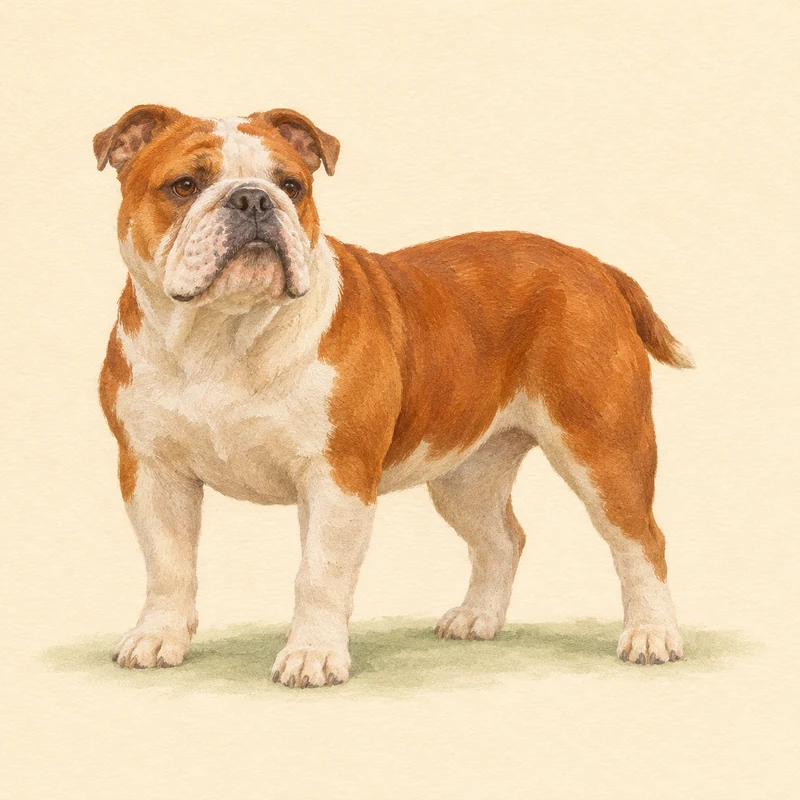
The Royal Kennel Club links the Bulldog’s history to bull baiting in Britain and later development as a companion after the activity was outlawed. This guide concerns the English or British Bulldog. Historical identity does not justify exaggerated features or breathing distress.
Read the evidence: Bulldog background and screening — Royal Kennel Club
Meet the individual behind the reputation
The standard describes an affectionate, alert and loyal ideal. That is not proof of safety around children or tolerance of every interaction. Ask how the particular dog responds to handling, visitors and a busy home.
Editorial application, not a breed-specific trial or guaranteed behavioural outcome.
Read the evidence: Bulldog breed standard — Royal Kennel Club
Short hair is not the whole job
The standard describes a fine, short, smooth coat. Skin folds create a separate care task: a neatly brushed coat does not establish that the skin beneath folds is comfortable or healthy.
Read the evidence: Bulldog breed standard — Royal Kennel Club · Bulldog background and screening — Royal Kennel Club
Keep learning comfortable
Reward an easy settle in a comfortable place, with breaks. Do not use pressure or insist on completing a task when the dog is worried or struggling.
Editorial application, not a breed-specific trial or guaranteed behavioural outcome.
Read the evidence: Reward-based training — Australian Veterinary Association
Completeness first, portions next
Choose complete life-stage food and review portions against body condition with your vet. Rewards contribute to the day’s intake too.
Read the evidence: Evaluating Pet Food — NC State Veterinary Hospital · Nutrition — Virginia Tech Veterinary Teaching Hospital
Breathing comes before distance
Avoid excessive heat and humidity and keep activity within comfortable limits. Do not push through noisy, laboured breathing to finish a walk. A respiratory crisis needs immediate emergency veterinary care. A fixed exercise quota cannot account for an individual Bulldog’s airway health.
Read the evidence: Brachycephalic Obstructive Airway Syndrome — Cornell University College of Veterinary Medicine
Revisit feeding as health changes
Growth, adult activity and later health changes can call for different feeding decisions. Ask your vet to review the plan rather than simply carrying puppy portions into adulthood.
Read the evidence: Evaluating Pet Food — NC State Veterinary Hospital · Nutrition — Virginia Tech Veterinary Teaching Hospital
Ask for assessment, not visual reassurance
Brachycephalic obstructive airway syndrome (BOAS) can obstruct breathing in English Bulldogs. Current Royal Kennel Club guidance includes respiratory function grading and eye screening. Ask what the individual dog and its parents have been assessed for and what the findings mean. Neither a pleasant appearance nor screening paperwork proves that a dog will remain healthy.
Read the evidence: Brachycephalic Obstructive Airway Syndrome — Cornell University College of Veterinary Medicine · Bulldog background and screening — Royal Kennel Club
Brush gently and notice folds
Use gentle brushing for the short coat. Check folds separately; persistent redness, odour or soreness needs veterinary advice, not more vigorous brushing.
Read the evidence: Dog Grooming Tips — ASPCA · Bulldog background and screening — Royal Kennel Club
Do not leave folds damp
Keep water out of eyes, ears and nose. Clean surface dirt from folds gently with a damp cloth and dry thoroughly. Ask your vet about sore skin.
Read the evidence: Dog Grooming Tips — ASPCA
Never normalise respiratory distress
Snoring or snorting should not be dismissed as a harmless breed joke. Discuss persistent noisy breathing with your vet. Struggling to breathe, blue gums or collapse require immediate emergency veterinary care. Do not run a home exercise test to see how much the dog can tolerate.
Read the evidence: Brachycephalic Obstructive Airway Syndrome — Cornell University College of Veterinary Medicine
Sources & scope
Source retrieval dates are recorded individually below. Written as general owner education by Good Dog; not clinically reviewed or endorsed by the organisations linked below. Breed standards describe ideals, not guarantees. Screening advice can change. These are selected considerations, not a complete list of conditions.
- Bulldog background and screening — Royal Kennel Club
Breed history and current screening signposts; activity context.
Limitations: Secondary historical account; screening guidance may change. No exercise quota, lifespan promise or popularity ranking adopted.
Source retrieved 2026-11-11 - Bulldog breed standard — Royal Kennel Club
Temperament ideals and coat description; not individual predictions.
Limitations: Show standard, not a temperament trial, health examination or disease survey.
Publication or revision: 1 August 2025
Source retrieved 2026-11-11 - Reward-based training — Australian Veterinary Association
Positive reinforcement and risks of pain/fear-based methods.
Limitations: General policy, not breed-specific efficacy evidence. Individual practice examples are editorial applications.
Publication or revision: 5 November 2021 ratification
Source retrieved 2026-11-11 - Evaluating Pet Food — NC State Veterinary Hospital
Complete life-stage nutrition and individual veterinary assessment.
Limitations: US label examples are not UK legal requirements. No product recommendations, recipes or transition schedule adopted.
Source retrieved 2026-11-11 - Nutrition — Virginia Tech Veterinary Teaching Hospital
Body condition, individual portions and review when appetite or health changes.
Limitations: No products, recipes, supplements or suggested waiting period for appetite loss adopted; US label advice not imposed on UK food.
Source retrieved 2026-11-11 - Brachycephalic Obstructive Airway Syndrome — Cornell University College of Veterinary Medicine
English Bulldog and Lhasa Apso inclusion; signs, heat caution, urgent respiratory-crisis referral.
Limitations: Clinical owner education, not diagnosis or prevalence research. No treatment, surgery, home test or individual prognosis adopted.
Source retrieved 2026-11-11 - Dog Grooming Tips — ASPCA
Selected gentle brushing, bathing, fold drying and skin/eye referral guidance.
Limitations: Charity owner guidance with affiliate links. No fixed bathing interval, ear treatment, supplements or home scissors instructions adopted.
Source retrieved 2026-11-11