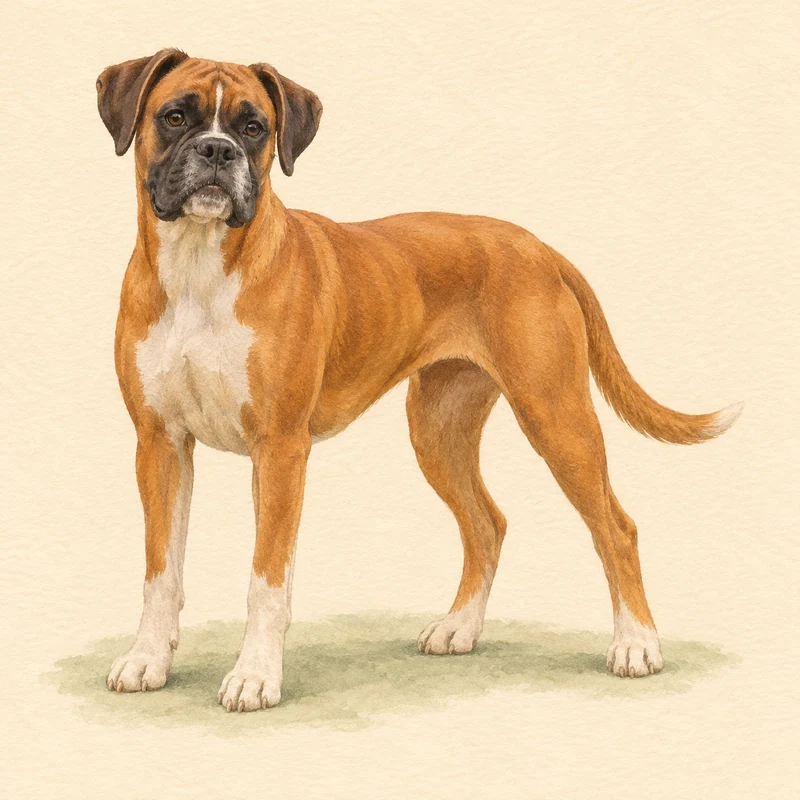
A German working background
The Royal Kennel Club traces the Boxer to the German Bullenbeisser, with Bulldog ancestry thought to have contributed to its development. The breed later worked in roles including military messaging and carrying. This is historical context, not a job description for a companion dog.
Read the evidence: Boxer breed background and health screening — Royal Kennel Club
Confidence is not a promise
The standard’s ideal is self-assured and responsive to handling. It does not establish that every Boxer is safe with strangers or children. Ask how the individual copes with visitors, excitement and interruptions to rest.
Read the evidence: Boxer breed standard — Royal Kennel Club
A close-fitting smooth coat
The standard describes short, smooth, glossy hair close to the body. A short coat still deserves a gentle care routine.
Read the evidence: Boxer breed standard — Royal Kennel Club
Practise a calm greeting
Use rewards, not intimidation. As a practical exercise, reward keeping four paws on the floor during a low-key greeting, then pause before excitement builds. The aim is a manageable routine, not a claim that one technique suits every Boxer.
Read the evidence: Reward-based training — Australian Veterinary Association
Food for the dog in front of you
Choose complete life-stage food. Review portions as body condition and activity change, rather than feeding to a muscular breed image.
Read the evidence: Nutrition — Virginia Tech Veterinary Teaching Hospital
Activity with room to recover
Plan walks, sniffing, play and rest, with safe enclosed space where appropriate. Adjust activity to fitness and health. If there are breathing concerns, get veterinary advice instead of using a fixed breed target to push through them.
Read the evidence: Boxer — PDSA · Boxer breed background and health screening — Royal Kennel Club
Growth deserves its own food plan
Ask your vet about growth-appropriate feeding and the eventual move to adult food. Later dietary changes should reflect health and body condition, not just a birthday.
Read the evidence: Evaluating Pet Food — NC State Veterinary Hospital · Nutrition — Virginia Tech Veterinary Teaching Hospital
DNA testing is only part of the picture
NC State describes Boxer arrhythmogenic right ventricular cardiomyopathy (ARVC) as an inherited heart-muscle disease that can appear in adulthood. A dog with an associated mutation may never develop signs, while a negative test for known mutations does not exclude ARVC. Discuss cardiac assessment and monitoring with your vet; a DNA result alone cannot settle the question.
Read the evidence: Arrhythmogenic Right Ventricular Cardiomyopathy in Boxers — NC State Veterinary Hospital
Keep coat care gentle
A regular gentle brush helps manage loose hair. Use the quiet time to notice changes rather than treating a glossy coat as proof that everything else is well.
Read the evidence: Boxer — PDSA
Keep water away from the face
Rinse carefully without directing water into the eyes or nose, then dry thoroughly.
Read the evidence: Dog Grooming Tips — ASPCA
Manage size and excitement
Supervise interactions with children and vulnerable adults. Arrange space for the dog to rest without being disturbed. A strong, enthusiastic dog needs sensible household management; neither a playful label nor a guarding history predicts every interaction.
Read the evidence: Boxer — PDSA
Sources & scope
Source retrieval dates are recorded individually below. Written as general owner education by Good Dog; not clinically reviewed or endorsed by the organisations linked below. Breed standards describe ideals, not guarantees. Screening advice can change. These are selected considerations, not a complete list of conditions.
- Boxer breed background and health screening — Royal Kennel Club
Historical background and listed screening; broad activity context.
Source retrieved 2026-11-11 - Boxer breed standard — Royal Kennel Club
Coat and temperament ideal; physical description.
Source retrieved 2026-11-11 - Reward-based training — Australian Veterinary Association
Positive reinforcement and avoiding fear/pain-based training.
Source retrieved 2026-11-11 - Nutrition — Virginia Tech Veterinary Teaching Hospital
Body condition, portions, treats and life-stage dietary review.
Source retrieved 2026-11-11 - Boxer — PDSA
Selected exercise, grooming and supervised-interaction guidance.
Source retrieved 2026-11-11 - Evaluating Pet Food — NC State Veterinary Hospital
Complete life-stage food and individual veterinary advice.
Source retrieved 2026-11-11 - Arrhythmogenic Right Ventricular Cardiomyopathy in Boxers — NC State Veterinary Hospital
Hereditary adult-onset ARVC; limits of DNA results; veterinary monitoring discussion.
Source retrieved 2026-11-11 - Dog Grooming Tips — ASPCA
Selected bathing, brushing, fold drying and eye/ear warning advice.
Source retrieved 2026-11-11