Editorial context: practical handling ideas and questions are examples, not tested breed-specific outcomes or guarantees. Read the source scope and limitations below.
Training games and household examples are editorial applications. Health-screening items are selected current pre-breeding signposts, not a complete list of illnesses or an individual health assessment.
A name from the border country
The Royal Kennel Club connects the breed name with Northumberland and the Scottish border, where these dogs worked with the Border Foxhounds. Reedwater Terrier and Coquetdale Terrier are earlier local names in that account. This history describes a working role, not a requirement to recreate hunting in a companion home.
Inherit the specific scope and limitations of cited sources.
Read the evidence: Border Terrier background and screening — Royal Kennel Club
Energy without a stereotype
The standard values an active, game terrier. Ask about this dog’s response to movement, unfamiliar dogs and being left alone rather than assuming a small terrier will fit any household. The registry background flags digging and chasing: management matters even when a dog is affectionate with people.
Editorial example based on the cited general guidance, not a breed-specific trial finding or individual prediction.
Read the evidence: Border Terrier standard — Royal Kennel Club · Border Terrier background and screening — Royal Kennel Club
A rugged surface with an undercoat
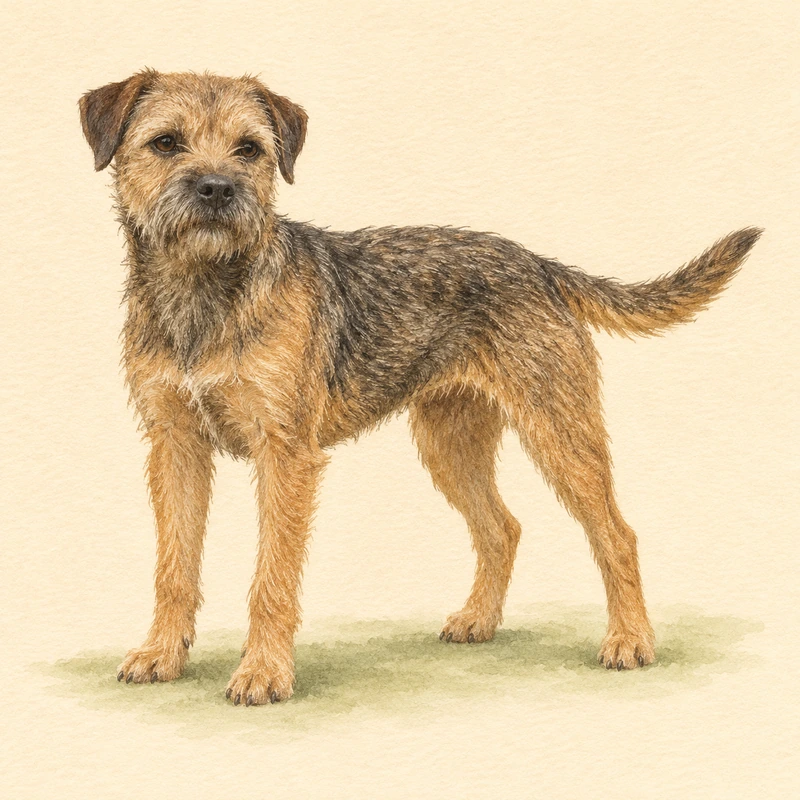
The standard describes a harsh, dense coat over a close undercoat. The outline can look pleasantly informal without being neglected. Choose a maintenance approach with a groomer who can assess the actual coat; a show texture is not a reason to persist with uncomfortable handling.
Editorial example based on the cited general guidance, not a breed-specific trial finding or individual prediction.
Read the evidence: Border Terrier standard — Royal Kennel Club · Reward-based dog training — Australian Veterinary Association
Practise turning back before distractions
Try rewarding a voluntary look back towards you in a quiet enclosed space, then let the dog resume investigating. Make the task easy before adding distractions. This is an everyday reward-based practice idea, not evidence that recall training removes the need for secure boundaries.
Editorial example based on the cited general guidance, not a breed-specific trial finding or individual prediction.
Read the evidence: Reward-based dog training — Australian Veterinary Association · Border Terrier background and screening — Royal Kennel Club
Do not turn breed identity into a restriction
Choose complete food appropriate to life stage and individual health. Do not start an exclusion diet simply because the dog is a Border Terrier; ask your vet to assess any symptoms and dietary concerns.
Editorial example based on the cited general guidance, not a breed-specific trial finding or individual prediction.
Read the evidence: Evaluating Pet Food — NC State Veterinary Hospital
Give investigation a safe setting
A sniffing route or a supervised search for a familiar toy can offer variety without encouraging pursuit of wildlife. Check gates and fencing before garden time. Plan activity around age, fitness and comfort rather than treating a registry time category as a compulsory target.
Editorial example based on the cited general guidance, not a breed-specific trial finding or individual prediction.
Read the evidence: Border Terrier background and screening — Royal Kennel Club
Review the feeding plan as routines change
A puppy’s feeding needs and an older dog’s quieter routine are not interchangeable. Review portions and body condition with your vet, especially when appetite or weight changes unexpectedly.
Inherit the specific scope and limitations of cited sources.
Read the evidence: Nutrition — Virginia Tech Veterinary Teaching Hospital
Ask specifically about SLEM
The current Royal Kennel Club page lists DNA testing for spongiform leucoencephalomyelopathy, abbreviated SLEM, under good practice. Ask for the relevant records and help interpreting them. This is a named screening signpost, not a diagnosis of any dog that shakes, nor a claim that one result excludes every neurological problem.
Editorial example based on the cited general guidance, not a breed-specific trial finding or individual prediction.
Read the evidence: Border Terrier background and screening — Royal Kennel Club
Look beneath the wiry surface
Use gentle brushing to remove debris and check for tangles where equipment rubs. Persistent discomfort is a reason to stop and seek help, not brush harder.
Editorial example based on the cited general guidance, not a breed-specific trial finding or individual prediction.
Read the evidence: Dog Grooming Tips — ASPCA · Coat Care: Preventing Matted Hair — USDA APHIS
Keep washing straightforward
When a bath is needed, use a dog-appropriate shampoo, rinse thoroughly and dry well. Avoid directing water into the eyes or ears.
Inherit the specific scope and limitations of cited sources.
Read the evidence: Dog Grooming Tips — ASPCA
Treat boundaries as part of care
Before opening an outside door, know where the dog is. A fenced space needs checking for gaps and digging, not just an assumption that the terrier is too small to escape. Keep encounters with small pets carefully managed; familiarity is not a guarantee against chasing.
Editorial example based on the cited general guidance, not a breed-specific trial finding or individual prediction.
Read the evidence: Border Terrier background and screening — Royal Kennel Club
Sources & scope
Source retrieval dates are recorded individually below. Written as general owner education by Good Dog; not clinically reviewed or endorsed by the organisations linked below. Breed standards describe ideals, not guarantees. Screening advice can change. These are selected considerations, not a complete list of conditions.
- Border Terrier background and screening — Royal Kennel Club
Attributed history and current pre-breeding screening signposts.
Limitations: Secondary historical narrative; screening listings are time-sensitive and not an individual health guarantee. Fixed activity quotas and lifespan claims excluded.
Source retrieved 2026-11-11 - Border Terrier standard — Royal Kennel Club
Temperament ideals and coat description.
Limitations: Conformation standard, not behaviour research or a clinical assessment. No working capacity or individual temperament guarantee adopted.
Publication or revision: 1 April 2026
Source retrieved 2026-11-11 - Reward-based dog training — Australian Veterinary Association
Positive reinforcement rather than pain or fear.
Limitations: General veterinary policy; the particular practice games in these guides are editorial examples, not tested breed-specific interventions.
Publication or revision: 5 November 2021 ratification
Source retrieved 2026-11-11 - Evaluating Pet Food — NC State Veterinary Hospital
Complete life-stage food and individual veterinary advice.
Limitations: US label examples are not UK regulation. Brands, recipes and transition percentages excluded.
Source retrieved 2026-11-11 - Nutrition — Virginia Tech Veterinary Teaching Hospital
Individual portions, life-stage review and appetite/weight changes.
Limitations: No suggested waiting period for appetite loss, recipes, supplement doses or US labelling requirements adopted.
Source retrieved 2026-11-11 - Dog Grooming Tips — ASPCA
Gentle brushing, bathing, eye/ear water avoidance and drying.
Limitations: Charity page includes affiliate links. Fixed bath frequency, ear packing, eye lubricant and home cutting instructions excluded.
Source retrieved 2026-11-11 - Coat Care: Preventing Matted Hair — USDA APHIS
Friction sites, mat discomfort and injury risk.
Limitations: Professional removal of tight mats is conservative editorial advice; the source itself discusses scissors and clippers, not a ban.
Publication or revision: Issued October 2018; reviewed February 2024
Source retrieved 2026-11-11