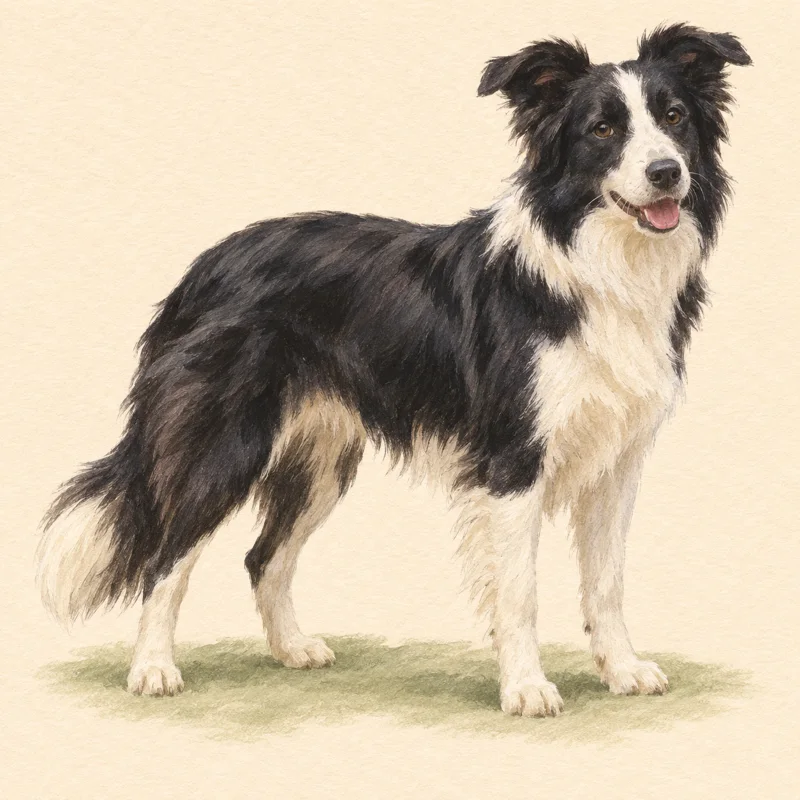
Origins and heritage
The Border Collie’s history lies in herding sheep and cattle around Britain’s border regions. Working ability remains central to its identity; a pet home needs to consider that background without treating the dog as a machine that must always be busy.
Read the evidence: Border Collie: breed background — Royal Kennel Club
Personality, without promises
The standard describes an alert, responsive dog. Quick learning is not automatic ease of ownership. Notice what excites or worries your own Collie, and do not judge them against a competition dog or an internet training clip.
Read the evidence: Border Collie: breed standard — Royal Kennel Club
Understanding the coat
Both smooth and moderately long varieties have an outer coat and a soft, dense undercoat. Longer coats have more feathering, but a smooth Collie also needs coat checks and help removing loose hair.
Read the evidence: Border Collie: breed standard — Royal Kennel Club
Learning for everyday life
Reward useful behaviour. Practise recall, loose-lead walking and relaxed handling in manageable steps.
Read the evidence: Reward-based training — Australian Veterinary Association
Food for the individual
Choose complete, life-stage-appropriate food; discuss body condition and any prescribed diet with your vet.
Read the evidence: Nutrition — Virginia Tech Veterinary Teaching Hospital
Movement with a purpose
Use breed history as context, not a daily exercise prescription. Let age, comfort, fitness and weather shape the plan. Your dog does not need to excel at their breed’s traditional job to have a fulfilling day.
Read the evidence: Border Collie: breed background — Royal Kennel Club
Puppy, adult and mature years
Young dogs: introduce experiences gently; stop when worried. Try a pause on a mat between learning tasks. Discuss safe socialisation with your vet.
All ages: choose safe activities your dog enjoys. An idea to try: finding a named familiar toy. These are options, not breed requirements or a test of intelligence.
Mature dogs: adapt activities to ability with veterinary advice. For example, reduce the search area rather than adding speed. Keep companionship and enjoyable choices in their day.
Read the evidence: Puppy socialisation — UC Davis Veterinary Medicine · Environmental enrichment — Purdue Canine Welfare Science · Senior dog enrichment — Cornell University
Health conversations worth having
PDSA identifies hip dysplasia, Collie eye anomaly and epilepsy among the breed’s possible health concerns. Ask about current parental tests and family history. Not every condition has a screening test, and a test panel is not a lifetime health guarantee.
Read the evidence: Border Collie health — PDSA
Brushing and cleaning
Check behind the ears, under harness contact points and through longer feathering. Adjust brushing to coat length and shedding rather than treating all Border Collies alike. Stop if an area is painful or badly tangled.
Read the evidence: Border Collie: breed standard — Royal Kennel Club · Dog grooming tips — ASPCA
Keep care comfortable
Painful skin or severe matting needs professional help. Avoid cutting knots close to skin.
Do not insert cotton buds into ears. Ask your vet about pain, discharge or persistent odour.
Read the evidence: Coat care: preventing matted hair — USDA APHIS · How to clean your dog’s ears — Cornell University
Sources & scope
Source retrieval dates are recorded individually below. Written as general owner education by Good Dog; not clinically reviewed or endorsed by the organisations linked below. Breed standards describe ideals, not guarantees. Screening advice can change. These are selected considerations, not a complete list of conditions.
- Border Collie: breed background — Royal Kennel Club
Breed origins and broad activity context; not an individual exercise prescription.
Source retrieved 2026-11-10 - Border Collie: breed standard — Royal Kennel Club
Coat and temperament ideals; paraphrased, not guarantees about an individual.
Source retrieved 2026-11-10 - Reward-based training — Australian Veterinary Association
Positive reinforcement; avoid fear/pain-based training.
Source retrieved 2026-11-10 - Nutrition — Virginia Tech Veterinary Teaching Hospital
Life-stage complete diet, body condition and individual nutritional assessment.
Source retrieved 2026-11-10 - Puppy socialisation — UC Davis Veterinary Medicine
Brief positive experiences and gentle handling; veterinary vaccination context.
Source retrieved 2026-11-10 - Environmental enrichment — Purdue Canine Welfare Science
Individual preferences and safe activity at all ages. Specific suggested games are editorial applications, not breed requirements.
Source retrieved 2026-11-10 - Senior dog enrichment — Cornell University
Adapt activity to ability and discuss safe choices with a vet.
Source retrieved 2026-11-10 - Border Collie health — PDSA
Selected health concerns and screening discussions. No prevalence estimates or treatment advice adopted.
Source retrieved 2026-11-10 - Dog grooming tips — ASPCA
Gentle brushing by coat type, face cleaning and bathing. Older ear-cleaner advice not adopted; Cornell takes precedence.
Source retrieved 2026-11-10 - Coat care: preventing matted hair — USDA APHIS
Friction-area mats, variable grooming frequency and risks from matting or scissors.
Source retrieved 2026-11-10 - How to clean your dog’s ears — Cornell University
Avoid overcleaning and cotton buds; pain/odour requires veterinary advice.
Source retrieved 2026-11-10