Editorial context: practical handling ideas and questions are examples, not tested breed-specific outcomes or guarantees. Read the source scope and limitations below.
A travelling companion background
The Royal Kennel Club places the Bichon family in the Mediterranean and describes France as the country where this breed developed. Its account links earlier Bichons with Tenerife and trade into mainland Europe. This is a breed-history account, not a complete archival record.
Read the evidence: Bichon Frise background and screening — Royal Kennel Club
An outgoing ideal
Friendly and outgoing are the standard’s aims, not a guarantee that every Bichon enjoys busy greetings. Ask about the dog’s experience of visitors, time alone and grooming before planning a new household routine.
Editorial application, not a breed-specific trial or guaranteed behavioural outcome.
Read the evidence: Bichon Frise breed standard — Royal Kennel Club
Curls are a care commitment
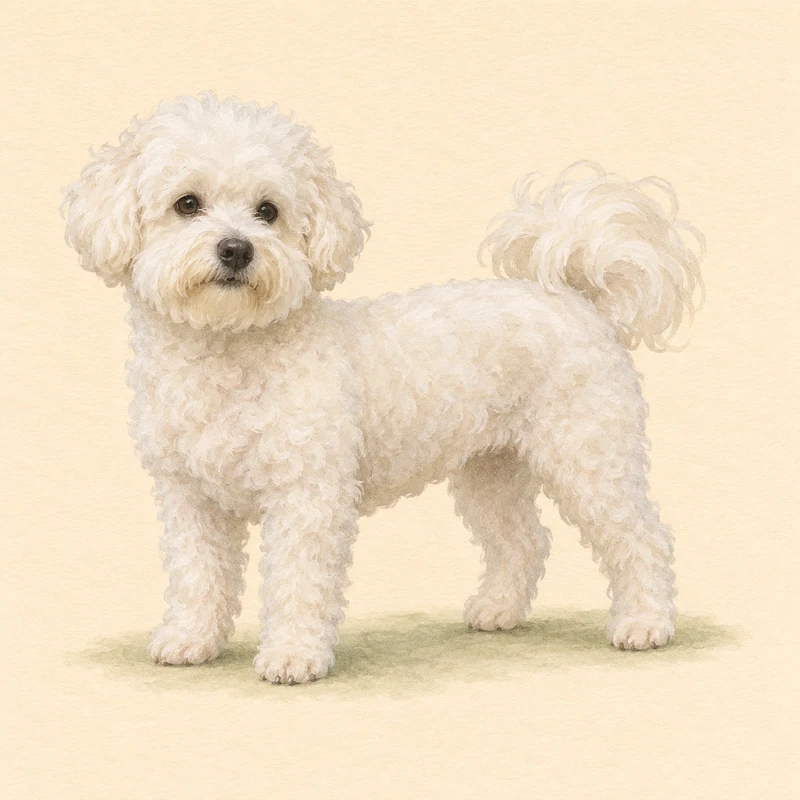
The standard describes fine, silky hair with soft corkscrew curls. A rounded haircut is a presentation choice. Ask a groomer which manageable length and maintenance routine suit the coat in front of you.
Editorial application, not a breed-specific trial or guaranteed behavioural outcome.
Read the evidence: Bichon Frise breed standard — Royal Kennel Club
Practise a calm grooming pause
Reward an easy moment of standing comfortably, then take a break. Gradual, willing participation is a better goal than holding the dog still through worry.
Editorial application, not a breed-specific trial or guaranteed behavioural outcome.
Read the evidence: Reward-based training — Australian Veterinary Association
Start with a complete diet
Choose complete life-stage food and discuss individual health needs with your vet. Coat colour is not a basis for selecting a special diet.
Read the evidence: Evaluating Pet Food — NC State Veterinary Hospital
Make exploration part of the day
A small companion still needs opportunities to move and explore. An easy sniffing route or a gentle game in a safe space can add variety. Treat these as starting ideas, adjusting to the dog’s fitness rather than following a fixed daily quota.
Editorial application, not a breed-specific trial or guaranteed behavioural outcome.
Read the evidence: Bichon Frise background and screening — Royal Kennel Club
Keep portions under review
Include rewards when reviewing the day’s food. If appetite, weight or activity changes, ask your vet whether portions or the feeding plan need adjustment.
Read the evidence: Nutrition — Virginia Tech Veterinary Teaching Hospital
Ask about eye-screening records
Eye testing through the BVA/KC/ISDS scheme appears in the Royal Kennel Club’s current good-practice guidance. Ask what was examined, when, and what the result can and cannot establish. A screening result is not a lifetime health guarantee.
Read the evidence: Bichon Frise background and screening — Royal Kennel Club
Check beneath the fluffy outline
Regular brushing helps prevent mats, especially where hair rubs behind ears and under a harness. Ask for help with tight knots instead of tugging.
Read the evidence: Coat Care: Preventing Matted Hair — USDA APHIS
Untangle before wetting
Address tangles before a bath. Keep water out of eyes and ears, rinse thoroughly, and dry the coat carefully.
Read the evidence: Dog Grooming Tips — ASPCA
Plan for maintenance, not perfection
Before choosing a Bichon, work out who will manage coat care and appointments. A shorter practical style still needs upkeep. Judge success by comfortable, clean, mat-free hair rather than whether the outline looks ready for a show ring.
Editorial application, not a breed-specific trial or guaranteed behavioural outcome.
Read the evidence: Coat Care: Preventing Matted Hair — USDA APHIS · Bichon Frise breed standard — Royal Kennel Club
Sources & scope
Source retrieval dates are recorded individually below. Written as general owner education by Good Dog; not clinically reviewed or endorsed by the organisations linked below. Breed standards describe ideals, not guarantees. Screening advice can change. These are selected considerations, not a complete list of conditions.
- Bichon Frise background and screening — Royal Kennel Club
Breed history and current screening signposts; activity context.
Limitations: Secondary historical account; screening guidance may change. No exercise quota, lifespan promise or popularity ranking adopted.
Source retrieved 2026-11-11 - Bichon Frise breed standard — Royal Kennel Club
Temperament ideals and coat description; not individual predictions.
Limitations: Show standard, not a temperament trial, health examination or disease survey.
Publication or revision: April 2025
Source retrieved 2026-11-11 - Reward-based training — Australian Veterinary Association
Positive reinforcement and risks of pain/fear-based methods.
Limitations: General policy, not breed-specific efficacy evidence. Individual practice examples are editorial applications.
Publication or revision: 5 November 2021 ratification
Source retrieved 2026-11-11 - Evaluating Pet Food — NC State Veterinary Hospital
Complete life-stage nutrition and individual veterinary assessment.
Limitations: US label examples are not UK legal requirements. No product recommendations, recipes or transition schedule adopted.
Source retrieved 2026-11-11 - Nutrition — Virginia Tech Veterinary Teaching Hospital
Body condition, individual portions and review when appetite or health changes.
Limitations: No products, recipes, supplements or suggested waiting period for appetite loss adopted; US label advice not imposed on UK food.
Source retrieved 2026-11-11 - Coat Care: Preventing Matted Hair — USDA APHIS
Mat prevention and friction sites; pain and skin injury risk.
Limitations: Professional help rather than home cutting is a conservative editorial choice; no claim that the source prohibits all scissors.
Publication or revision: Issued October 2018; reviewed February 2024
Source retrieved 2026-11-11 - Dog Grooming Tips — ASPCA
Selected gentle brushing, bathing, fold drying and skin/eye referral guidance.
Limitations: Charity owner guidance with affiliate links. No fixed bathing interval, ear treatment, supplements or home scissors instructions adopted.
Source retrieved 2026-11-11