Built to follow a scent
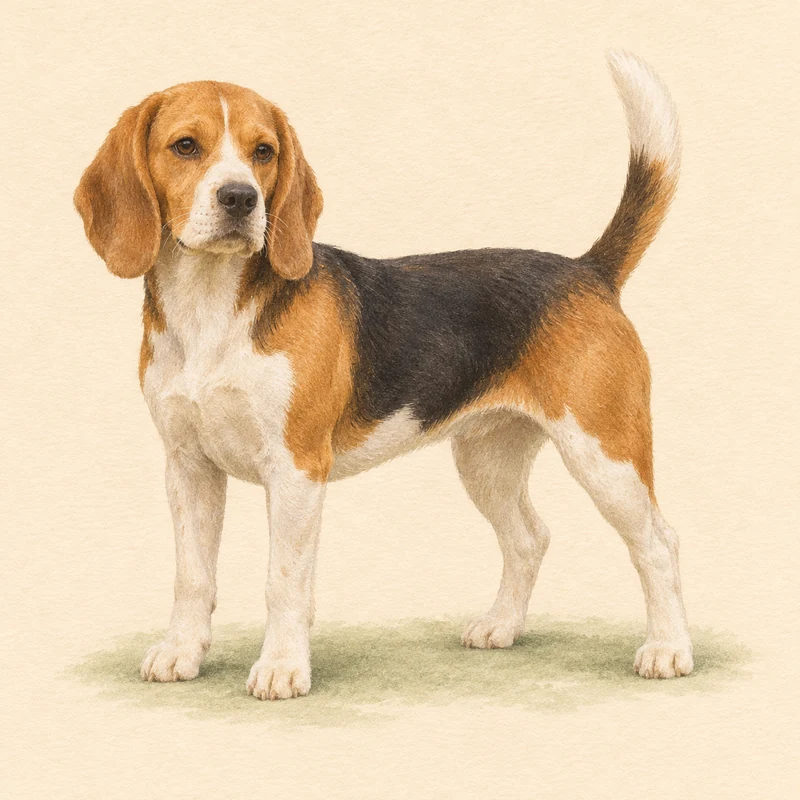
The Beagle’s history is that of a British pack hound hunting small game with people following on foot. Its standard still describes scent-following work. That context is more useful for planning walks than treating the breed as simply a conveniently sized companion.
Read the evidence: Beagle breed background and health screening — Royal Kennel Club · Beagle breed standard — Royal Kennel Club
Friendliness is not a safety certificate
The standard describes an amiable, alert hound. It is a breeding ideal, not a promise about any dog’s response to children, visitors or other animals. Ask what the individual finds exciting or worrying.
Read the evidence: Beagle breed standard — Royal Kennel Club
Dense does not mean difficult
The standard describes a short, dense, weather-resistant coat. There is no need to infer a complex styling routine from that description.
Read the evidence: Beagle breed standard — Royal Kennel Club
Give the nose a useful job
Use reward-based training. A simple editorial exercise idea is to hide a small part of the normal food allowance in an easy, supervised search, then practise returning to you. Start with an easy task rather than competing with a compelling outdoor scent.
Read the evidence: Reward-based training — Australian Veterinary Association
Count rewards as food
Feed complete food matched to life stage. Include training rewards in the daily food plan and ask your vet to help review portions and body condition.
Read the evidence: Beagle — PDSA
Explore with boundaries
Offer walks, sniffing and play in secure surroundings. Check the garden for escape routes rather than assuming a fence is sufficient. Adjust activity to age and fitness; a breed exercise chart is not a prescription.
Read the evidence: Beagle — PDSA
Keep food matched to growth
A puppy needs food suitable for growth. Review the change to adult feeding with your vet, and seek individual dietary advice when health changes later in life.
Read the evidence: Evaluating Pet Food — NC State Veterinary Hospital
Read the screening record
The current Royal Kennel Club guidance lists pre-breeding DNA tests for Lafora’s disease and neonatal cerebellar cortical degeneration, with further tests under best practice. Ask to see the actual results and discuss their meaning with a vet. These tests concern specific inherited conditions, not a blanket health guarantee.
Read the evidence: Beagle breed background and health screening — Royal Kennel Club
Remove loose hair gently
Regular brushing helps manage loose hair in the short coat. Keep an eye on the ears as a separate care task; brushing the body does not check the ear flap.
Read the evidence: Beagle — PDSA
Rinse and dry carefully
Avoid directing water into the ears. Dry carefully after bathing rather than leaving the ears wet.
Read the evidence: Dog Grooming Tips — ASPCA
Make rest part of family life
Supervise time with children and create an undisturbed retreat. Plan how doors and gates will be managed when visitors arrive. These are household arrangements to work out before an interesting scent draws the dog outside.
Read the evidence: Beagle — PDSA
Sources & scope
Source retrieval dates are recorded individually below. Written as general owner education by Good Dog; not clinically reviewed or endorsed by the organisations linked below. Breed standards describe ideals, not guarantees. Screening advice can change. These are selected considerations, not a complete list of conditions.
- Beagle breed background and health screening — Royal Kennel Club
Historical background and listed screening; broad activity context.
Source retrieved 2026-11-11 - Beagle breed standard — Royal Kennel Club
Coat and temperament ideal; physical description.
Source retrieved 2026-11-11 - Reward-based training — Australian Veterinary Association
Positive reinforcement and avoiding fear/pain-based training.
Source retrieved 2026-11-11 - Beagle — PDSA
Selected exercise, grooming and supervised-interaction guidance.
Source retrieved 2026-11-11 - Evaluating Pet Food — NC State Veterinary Hospital
Complete life-stage food and individual veterinary advice.
Source retrieved 2026-11-11 - Dog Grooming Tips — ASPCA
Selected bathing, brushing, fold drying and eye/ear warning advice.
Source retrieved 2026-11-11